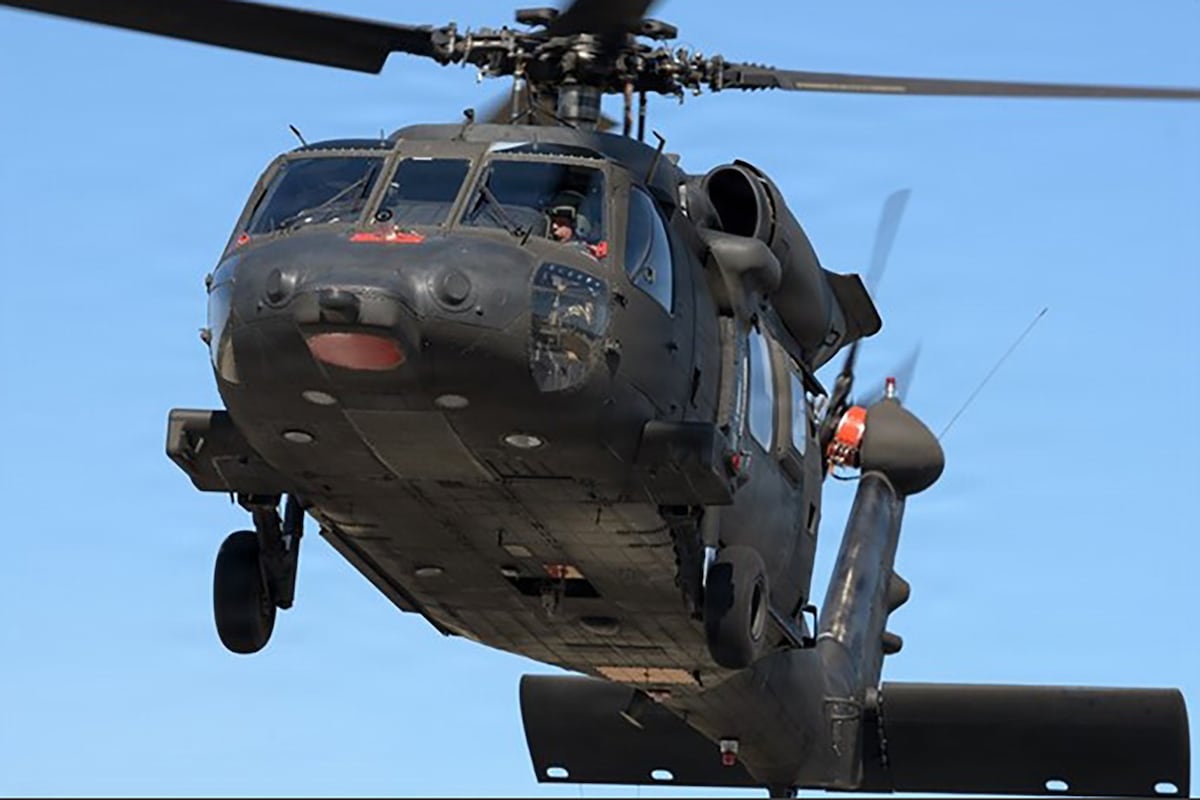

The Army has taken a step toward pilot-optional flight, receiving its first Black Hawk helicopter equipped with autonomy systems that allow it to fly without a human crew.
The service received the aircraft, designated H-60Mx, and said the Black Hawk variant will begin rigorous testing of its ability to operate with a reduced crew or autonomously.
According to a March 20 Army release, the helicopter uses autonomy software developed under a Defense Department program to enable flight with minimal human input.
The Army said the aircraft is modified with “fly-by-wire” controls, which replace mechanical systems with electronic ones that allow computer-assisted flight. The system allows onboard computers to interpret pilot inputs and adjust flight controls in real time, making the aircraft more stable and easier to handle in difficult conditions.
“Functioning like a highly advanced digital co-pilot, the system can manage the most complex tasks of flight, from takeoff to landing,” the statement reads. “This allows the helicopter to perform missions completely on its own or with a remote crew supervising from a secure ground station, offering unprecedented flexibility.”
The technology behind H-60Mx traces back to a Defense Advanced Research Projects Agency program known as Aircrew Labor In-Cockpit Automation System, or ALIAS, which began more than a decade ago to develop automation kits for aircraft already in use. The program was intended to create a removable autonomy kit that could be installed on existing aircraft to reduce crew workload so pilots could focus on other critical tasks.
Sikorsky, a Lockheed Martin subsidiary that manufactures the Black Hawk, worked with the Army to integrate the autonomy system onto the aircraft, the company said in a release.
In the coming months, Army test pilots and engineers will put the helicopter’s autonomy systems through rigorous testing, the Army said, to see how effectively the technology can be controlled from the ground and how successfully the systems perform in complex scenarios.
The Army said that this aircraft represents the start of a potentially larger initiative, as it is the serves as the “primary testbed” for the Strategic Autonomy Flight Enabler program, or SAFE, which seeks to create an autonomy kit that could be put into any of the Army’s Black Hawks.
The Army said it is working with Texas A&M University’s George H.W. Bush Combat Development Complex, which is also using ALIAS technology, to study how autonomous aircraft can be used for combatting wildfires, among other things.
The Army has tested autonomous technology in a Black Hawk before. In a 2025 training exercise, a U.S. Army National Guardsman used a touchscreen tablet to operate an Optionally Piloted Vehicle Black Hawk. The Guardsman transported a 2,900-pound water buffalo slingload, according to previous Military Times reporting.
Lockheed Martin announced the first autonomous Black Hawk flight in 2022, when the aircraft finished a 30-minute mission without a human in the cockpit.
The push towards autonomy goes beyond helicopters. Defense technology firm Shield AI in 2025 unveiled an autonomous vertical takeoff fighter jet, called X-BAT, that is designed to operate without runways.
Autonomy has also become a touchpoint of military innovation outside of aviation, with developments ranging from unmanned vehicles for mortar supply to autonomous drones to clean up chemical and biological weapons.
Eve Sampson is a reporter and former Army officer. She has covered conflict across the world, writing for The New York Times, The Washington Post and The Associated Press.
Read the full article here