
It’s hard to excite a Texas deer hunter about Montana’s prairie whitetails. With no feeders to concentrate them around bait, and no high fences to constrain their movement, Montana whitetails come as they are. Only last year, they didn’t come, and I suggested to Derrick Ratcliff that he do the same and sit out the season, even though he had drawn a perishable — and increasingly coveted — non-resident deer tag. I expected my downbeat assessment would discourage any results-oriented Texan worthy of the reputation.
The problem was: A moist, hot summer in northeast Montana had slumped into a hot, dry fall, the perfect incubator for the spread of what deer hunters call “blue-tongue” and what biologists call epizootic hemorrhagic disease, or EHD. Whatever you call it, it’s tragic. A tiny nippy gnat plants a virus that damages what’s called the endothelium, the shimmering single sheet of cells that line blood vessels in vascular animals. That simple disruption causes dozens of hemorrhages throughout a deer’s body, including the arteries, the heart and lungs, and even the tongue, nasal cavity, and stomach lining. They literally vomit blood.
The result is that, five to 10 days after infection, a deer inevitably dies a wretched, agonizing death. Victims of EHD overwhelmingly are whitetails because of their tendency to congregate around water sources and because of their conviviality. But it can infect mule deer and pronghorn antelope as well. Late-stage infection sends its victims to water to slake the ferocious thirst caused by their internal bleeding. Last September, I found dozens of freshly dead whitetails around my home in northeast Montana, nearly all of them floating in streams and around mud-caked pans of standing water.
By the time a killing frost stopped the spread of EHD-carrying gnats in late September, most of my region’s whitetails were either dead or redistributed away from water sources.
I was on the phone with Derrick, whom I encouraged a half a year ago — just prior to the April 1 deadline — to apply for a deer tag so we could hunt together. Now I was suggesting that he scrub his planned October trip.
There was an additional reason for my discouragement. I live in the heart of Montana’s prairie mule deer country, and if he had been cool about whitetails, Derrick had been equally excited by the prospect of connecting with a mature Montana mule deer buck. But a couple years of drought, combined with a tough winter and stubborn hunting pressure encouraged by Montana’s 5-week rifle season, had punched populations — and especially buck numbers — down to the lowest levels I had seen in my long tenure in eastern Montana.
I couldn’t, in good conscience, channel Derrick’s enthusiasm toward a mule deer. Now my backup plan — whitetails — would be hard to come by.
A Rifleman’s Perspective
Try as I might, Derrick was hard to discourage.
Partly, that’s because he recognizes that drawing a non-resident Montana deer tag isn’t as automatic as it once was. Conversations among buddies and with strangers across social media — along with stories like this one — have spread the news that Montana allows liberal hunting over a long season with abundant access in the form of public land and millions of acres of Block Management ground, private land that’s open to public hunting.
A long season on BLM land with lots of encounters and the chance of a good buck? What’s to hate? My part of eastern Montana saw a spike in activity over Covid, and it hasn’t let up, with both non-resident and out-of-area resident hunters spending weeks at a time pursuing deer. Sometimes any deer.
Related: Montana to Slash Nonresident Deer Tags Amid EHD Declines and Mounting Pressure from Out-of-Staters
It’s hard to deny the appeal. Montana’s general deer tag is what’s called by my cynical buddy a “hair tag.” That is, if it has hair, it’s fair game. Montana’s Deer A license allows resident and non-resident holders to harvest either a mule deer or a whitetail in any open unit, which is nearly the entire state, with the additional latitude that it can be filled with either sex, a buck or a doe, or even an antlerless fawn if that’s what you want. It’s a times-two-times-two license, another buddy says. Either a whitetail or a mule deer. Either an antlered buck or an antlerless deer.
Expanded interest in Montana’s liberal season structure, rare among its Western peers, has lowered draw odds. Last year, the general tag went to only about a third of first-time applicants. As with most limited commodities, there are ways to tip the odds in your favor. If you book with an outfitter, you get draw preference. If you have successive years of unsuccessful applications, you get more chances in the draw. Derrick had none of these, which made his Deer A tag even more worthwhile, and his interest in hunting even stronger when he drew it.
Plus, Derrick was as interested in the experience as in the outcome. Derrick is the founder of Horizon Firearms, a family-owned Texas firearms manufacturer that started mainly as a machine shop but has blown up with the popularity of its 22 Creedmoor chamberings and the bold styling of its rifles. The 22 Creed is a small-caliber center-fire cartridge that shoots flat, has minimal recoil but plenty of downrange impact, and has become the darling of predator hunters.
Derrick and I have been friends since the early days of his company, which has entered the mainstream with the introduction last year of the 25 Creedmoor, a modern cartridge design that marries flat-shooting, wind-bucking bullets with a modest case that doesn’t recoil as much as traditional .25-calibers. Derrick was interested in field-testing a Horizon in 25 Creed in Montana, taking full advantage of his either-sex, either-species allowance.
Back home, Derrick could hunt whitetails in the Texas way, which means lots of vehicles, feeders, and trail cameras that inventory the deer on any given property. Maybe as a reaction to that style, mule deer interested him with their promise of plenty of hiking, glassing, and strategizing on how to get in range. Montana’s whitetails were a distant second, especially after I assessed the extent of EHD, until I told Derrick that I had gotten permission to hunt a historic ranch on the Missouri River that seemed to have escaped catastrophic mortality and was full of whitetails.
Hunting Pearl’s Ranch
The Nickels Ranch stretches for several miles along the Missouri River below Fort Peck Dam, the huge earthen dam that was built damned near by hand during the Great Depression and holds back oceanic Fort Peck Reservoir. Freed of the dam, the Missouri is just getting its prairie character where it churns past the Nickels Ranch.
It’s a historic property. The ranch contains a couple of Lewis & Clark campsites dating from 1805 and its riverside timber was cut to fuel paddle-wheel steamboats that carried prospectors and merchants into Montana Territory in the 1870s and ‘80s, well before dams blocked the river, and delivered the state’s wealth downstream to St. Louis and points beyond.
In the river’s valley, the Nickels Ranch is a grid of irrigated alfalfa fields that attract hundreds of whitetails. But the property ranges out of the bottoms and into rough shale uplands that border public BLM ground way back in the hills.
The ranch had been widely open to public hunting for years, if only because then-owner Pearl Nickels wanted to reduce the number of hay-eating deer that descended on her place. But Pearl died a couple years ago, and the ranch management changed. Now it’s freshly leased by Milk River Outfitters, owned by longtime friend Eric Albus, who gave Derrick and me the green light to hunt the Nickels Place.
“Only thing I ask: Let me know how the game looks, and how you hunt it,” Albus told me. “That might help me on down the line as I start to learn how it hunts.”
It wasn’t lost on me that I was being asked to give an outfitter intel on a place I would probably never get the chance to hunt again.
I confess to another tension. I’m dismayed at the state of mule deer across much of eastern Montana. It’s not just this past year, or the year before that. It’s a long and steady decline in mature bucks across the eastern half of the state. I’ve recommend the state go to either a draw, or a pick-your-species, maybe a pick-your-weapon. Or hell, even a pick-your-region.
The point is that Montana’s liberal season worked very well for nearly the entire time I’ve been a Montana deer hunter. I could archery hunt river-bottom whitetails in September, maybe chase a mule deer buck with my bow in October, and then transition to a rifle and wait for the rut to fill my tag. That season structure has helped make me who I am as a deer hunter. But that long, liberal season isn’t sustainable in the growing trend of hunters who spend all season in the field, who have rifles and skills capable of making an 800-yard shot on a prairie buck, and who get to the back of beyond on lifted side-by-sides and never-stuck pickups.
The tension is that, even with all that pantomime cursing of non-residents, I was the host of one, and it’s been the role of hosts since at least biblical times to show their guests a good time.
That’s why I found myself watching dozens, then maybe hundreds, of whitetails feed out of the cottonwoods at dusk and enter Pearl Nickels’ fields, hoping one might appeal to Derrick.
Out of the Bottoms
Only we never saw a buck that was overly interesting to a buck hunter. Lots of 2-year-olds and a few basket-racked older deer. Maybe the older bucks would be out in the early morning, Derrick and I agreed, if we could sneak into sight of the fields before daylight.
The next morning, with the feeble moon low in the prairie sky, we snuck into place to glass Pearl’s fields. No remarkable whitetails, but we watched a group of mule deer bucks line out of the field at first light and head into the adobe hills. Derrick suggested we follow them, and then I wondered aloud if my pickup could navigate the ranch’s steep pasture trails.
We finished our coffee, waited for the whitetails to filter back in the timber, and headed for the hills, arriving just in time to see a string of seven mule deer bucks stitch across a pass. The last was a wide but light 3×3 that looked to be the best of the bunch.
The next hours were satisfyingly typical of many prairie mule deer hunts, with a measure of toss-about driving on distressing trails followed by hands-and-knees stalks to look into promising draws, tedious spells of glassing, and then more driving and stalking. We were on the driving portion of the hunt when I looked out my window and saw a handsome buck bedded in thin junipers directly below the ranch 2-track. I kept driving, employing a maxim of eastern Montana mule deer hunters, that if you keep driving and don’t make eye contact with the target animal, they’re frozen in place.
I parked out of sight of the deer. Derrick and I jumped out. I directed him to the location of the obviously oblivious buck.
We never found it. I had badly overshot the location of the buck, and by the time we saw him, he had seen us on the skyline and was bounding into the maze of cuts and coulees and shallow prairie swales. We lost sight of him behind a particularly sharp cutbank, a good mile into corduroy country.
A funny thing happens sometimes in the course of hunting with a good friend. By some property of quantum exchange, the hunt is shared equally, even though the shot is the responsibility of only one. I had seen that buck bounding out of sight, and had recognized it as a helluva trophy for this particular year anywhere in eastern Montana, and I was fully motivated to go kill it.
Derrick and I sat in the full sun and wondered aloud how to get back on this open-country buck. We compared landmarks, evaluated the wind and the terrain and pitched different approaches, knowing that the buck probably had kept going to the next county.
Finally, I employed a strategy that has never worked especially well for me before. I took out my laser rangefinder, lazed the distance to that cutbank, pulled out my phone, opened the onX app, and then identified that distinctive feature on the map. I confirmed the yardage with the distance-measuring feature on onX, and then Derrick and I used the digital map to chart a different approach into the cutbank.
Final Approach
We drove out of the adobes and parked on the rim above the irrigated alfalfa. Derrick allowed that either Lewis or Clark might have set foot on the very ground that we were about to enter, and we agreed that the prairie grizzlies the explorers had documented here wouldn’t be a problem for us on our stalk.
Then we fired up our apps and followed waypoints up creased coulees, over shallow ridges, into a larger drainage, and then directly opposite the cutbank, which took us a spell to recognize from this different orientation. We were ashamed to acknowledge what we both knew to be true: Our phones had led us to this spot.
Derrick cycled a round, and I stayed a few steps behind him as we cat-walked down the drainage below the cutbank, then up the other side. Then up another cut. Then do we turn right or left? Where’s the cutbank, again?
Read Next: Mexico’s 200-Inch Mule Deer Are Legendary. That Doesn’t Make Them Easy to Kill
Deep in a maze of prairie draws everything looks alike and nothing looks like deer. It’s easy to get disoriented, no matter what our phones told us, in the same-seeming khaki-colored hills. I volunteered to peek up one more coulee before we ditched the place and the idea, and as I followed a cow trail up the draw, I saw a flash through the wind-waved grass in front of me. It was an antler in the sun. I eased up and over, just enough to glass the buck, curiously facing me but oblivious to my presence. I took a quick photo and ducked back out of sight to fetch Derrick.
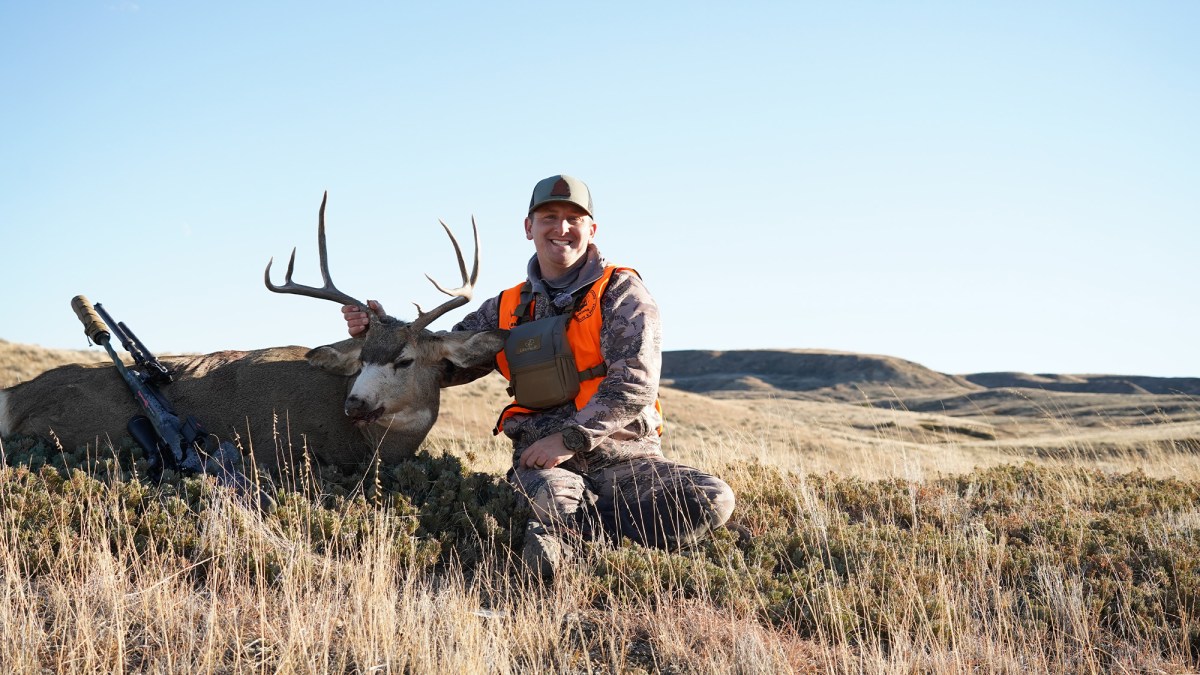
The rest of the hunt unfolded in the next minutes. Derrick eased into the same spot I had been, got behind his rifle, and while I stayed below him, suddenly pivoted his right. The buck appeared on the hillside above us as the 25 Creed sounded, and the buck went down and started rolling toward us.
Happily, it didn’t go far. Derrick and I yarded the buck to the nose of the ridge. We got some photos. And then we found our packs and our knives. The rest of the afternoon into the evening was filled with converting that cryptic prairie buck into quarters that we packed to the pickup and then into coolers for its journey to Texas.
A couple months after the season, Derrick texted me a photo of a bacon-wrapped mule deer roast glistening in a chestnut-colored reduction.
“If it tasted like this in 1805, I’m not sure why they kept going up the river,” he wrote, referencing Lewis & Clark’s Corps of Discovery.
Related:A fter More Than a Century of Conservation Efforts, Why Can’t We Recover America’s Buffalo?
Here in eastern Montana, we’ll continue to debate the best ways to grow our mule deer herd, recover our whitetails, and learn to share with the rest of the world. But I’m happy for the reminders that, in most years and with most people, it’s a treasure worth sharing.
Read the full article here