
We may earn revenue from the products available on this page and participate in affiliate programs. Learn More ›
Some of the most realistic turkey calls are feeding clucks, content yelps, and purrs. They’re also the calls that are least likely to spook a pressured tom since hens are constantly making those vocalizations.
A decent glass call can certainly make those sounds, but if you want the right tone and sound level, you’ll want to use this modification I learned from a champion turkey caller.
How to Make any Pot Call into a Two Sider
An Old School Pot Call Hack From a Champion Caller
I interviewed Dustin Jones, a Grand National Turkey Calling Champion and one of the top pot call makers, for an upcoming Outdoor Life podcast where he shared a simple tip for adding versatility to any call. Jones makes some of the best two-sided calls, in my opinion, which have a main playing surface and a surface on the bottom of the call. The idea is that you have the main surface for striking a bird and the bottom of the call for softer finishing calls. That’s why a glass top with a slate bottom is a classic two-sider combo.
But, you don’t need to buy a two-sided pot call to have that type of versatility. You can scuff a section of the bottom of your favorite call, add some box call chalk, and make shockingly good sounding calls right on the wood. Here’s how to do it.
Read Next: How to Condition a Pot Call
What You’ll Need
Step 1: Sand
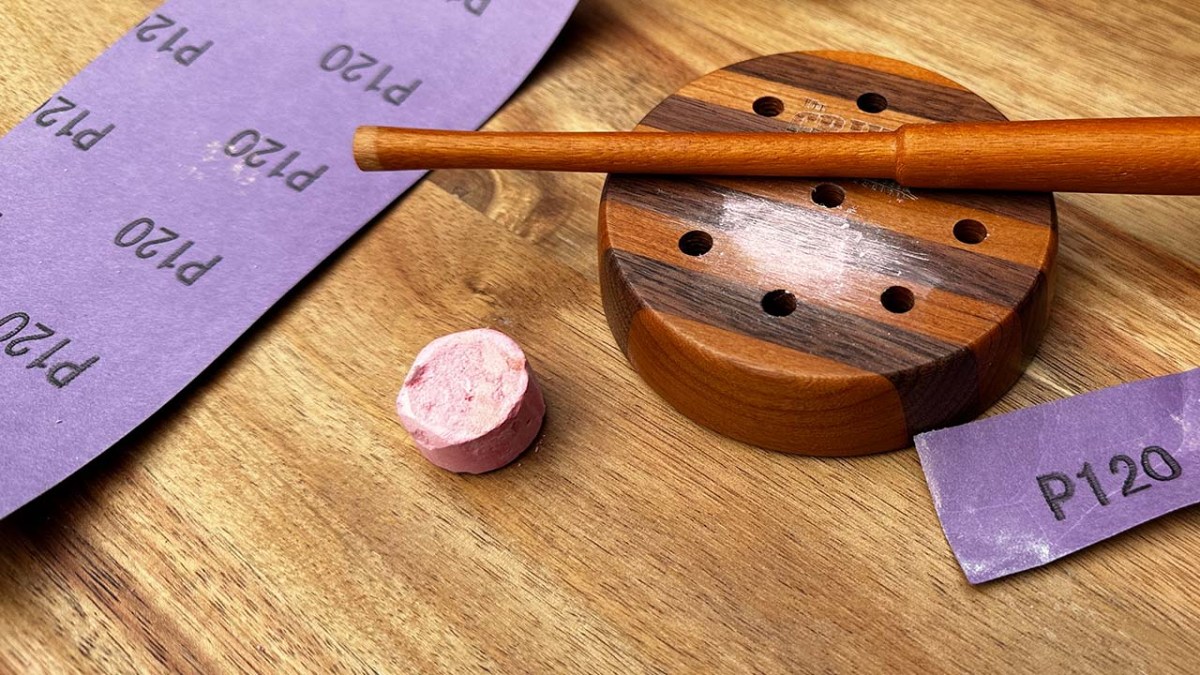
Sand a portion of the bottom of your pot call — a small area is all you need. Jones recommends sanding with the grain of the wood.
Step 2: Chalk
Add a little box call chalk to the sanded area.
Step 3: Run It
Don’t run the soft talker like you would cut and yelp on your main surface. “For clucks and purrs, you don’t want to hold it (the striker) real tight,” Jones says. “If you hold it real tight, it’s going to stiffen up the whole striker and you want that.” A loose grip allows the striker to vibrate more. Jones also says to hold the striker higher up to promote resonation.
Read Next: Best Turkey Calls
An Amateur’s Perspective
I’m not Dustin Jones, and my calling ability is squarely in the average classification. After talking with Jones, I decided to give this hack a try on one of my less precious calls. I used 120 grit sand paper to scuff up a .5 x .5-inch area. You’ll want to make sure you’re sanding down to the wood and not just on the surface finish. Then I rubbed some chalk on it and grabbed a striker. It was shockingly easy to run the call and it produced some nice, muted yelps, clucks, and purrs without much effort on my part. The main thing I noticed is that you’ll use less pressure than you think you need and holding the striker loose makes a big difference. If the striker starts to slip, hit the scuffed area with more chalk.
One of the coolest things about this pot call hack is that variations of it have been used throughout history. I’ve seen historical accounts of hunters scuffing up a section of their gun stock and using a nail as a striker.
Read the full article here