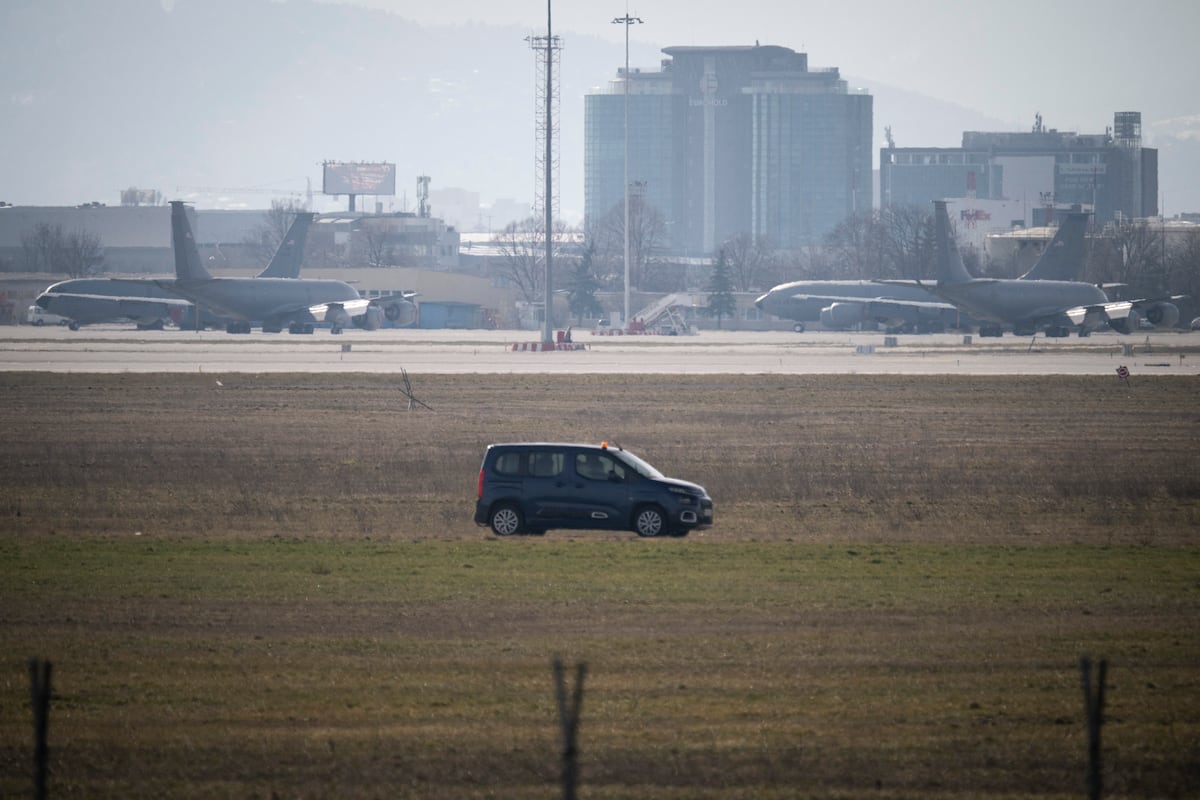

BERLIN — Bulgaria’s Sofia International Airport briefly suspended civilian air operations twice over the weekend while a fleet of American military aircraft staged at the facility, fueling speculation that Washington is positioning forces ahead of a potential strike on Iran.
A Notice to Airmen (NOTAM), verified by the Bulgarian investigative outlet Obektivno.BG, showed the airport restricted non-military operations on Feb. 23 from 01:15 to 02:50 local time and again on Feb. 24 from 01:05 to 03:35. Commercial flights are not ordinarily scheduled during this time frame.
Airport authorities attributed the brief closures to routine runway repairs and explicitly denied any link to the American military presence.
Photographs circulating on social media showed at least six KC-135 Stratotanker refueling aircraft from the 6th Air Refueling Wing at MacDill Air Force Base, Florida, along with C-17 and C-130 cargo planes and Boeing 747s typically used for troop transport, parked at the airport’s Terminal 1, according to Obektivno.BG.
Bulgaria’s Ministry of Defense confirmed the U.S. Air Force presence, describing the deployment as support for “training related to NATO’s enhanced vigilance activities,” with American personnel engaged solely in aircraft maintenance. Caretaker Foreign Minister Nadezhda Neynsky acknowledged her ministry had limited information and had ordered officials to collect additional details.
The Sofia staging is a small part of a much larger American military mobilization. The Bulgarian investigative journalists have tracked more than 120 U.S. Air Force aircraft that crossed the Atlantic within days, including four dozen F-16s, three squadrons of F-35A stealth fighters, and 12 F-22 Raptors.
Similar deployments, including F-22s staged at RAF Lakenheath, preceded last June’s Operation Midnight Hammer strikes on Iranian nuclear facilities. The USS Gerald R. Ford carrier strike group is also en route to join the USS Abraham Lincoln, which is already positioned in the Arabian Sea.
U.K. Prime Minister Keir Starmer has refused to grant Washington permission to use two critical British-controlled installations − RAF Fairford in Gloucestershire, the European forward base for U.S. heavy bombers including the B-2 and B-52, and the joint US-UK facility at Diego Garcia in the Indian Ocean − for any potential strike on Iran, The Times of London reported.
The buildup coincides with high-stakes nuclear diplomacy. American President Donald Trump, speaking at the inaugural meeting of his Board of Peace on Feb. 19, said he had given Tehran roughly ten days to reach a nuclear agreement, warning that “bad things will happen” if talks collapse. U.S. envoys Steve Witkoff and Jared Kushner met an Iranian delegation in Geneva last week, with Iran’s Foreign Minister Abbas Araghchi describing agreement on a set of “guiding principles,” though significant gaps remain between the two sides.
Bulgaria, a NATO member since 2004, maintains a Defense Cooperation Agreement with Washington signed in 2006 that permits U.S. forces to use Bulgarian military facilities.
Linus Höller is Defense News’ Europe correspondent and OSINT investigator. He reports on the arms deals, sanctions, and geopolitics shaping Europe and the world. He holds a master’s degrees in WMD nonproliferation, terrorism studies, and international relations, and works in four languages: English, German, Russian, and Spanish.
Read the full article here