Treacherous Country, Mischievous Horses, and One Missing Ram Turned Our DIY Sheep Hunt into a Rodeo

This story, “Do-It-Yourself Bighorns,” appeared in the December 1963 issue of Outdoor Life.
This pack trip really started one cold winter’s night in February in the coffee shop at the airline terminal in Calgary, Alberta. Three of us, all airline employees, were sipping coffee while waiting for a flight that was delayed by the blizzard. Although the temperature was 15 below and the visibility less than half a mile, the enforced idle-ness turned our thoughts to warm, clear September days.
I was a passenger agent with Trans-Canada Air Lines, and my two friends were station attendants in a different department. But it is natural for us to be talking together, for we’re all hunters.
At 30, I am the oldest, and I’ve taken elk, deer, moose, antelope, mountain goats, sheep, and black and grizzly bear in Alberta. Otto Krumes, two years younger, has taken all those species except sheep. Barrie Deakin, the youngster at 22, has taken the antlered species. We all had one common ambition: to take a trophy ram. Since our hunt, incidentally, Otto and Barrie have opened a sporting-goods store in Calgary, and I’ve become a quality analyst for T.C.A.
While the blizzard raged outside and the flight became progressively later, we set the stage for our hunt. We pored over maps, decided our holiday dates, and also decided that for transportation we would use horses. Four-wheel-drive transportation is possible in some areas, and backpacking possible in others on a short trip. But this year we would be playing for keeps.
I’m a Class “A” licensed guide, and in working with various outfitters I’ve learned the rudiments of handling a mountain pack oufit. Otto had owned a pony in his teens but never had used it for packing. Barrie’s experience with horses was mostly in the future.
Barrie, despite his lack of experience, proved invaluable as the detail man. During the following months he made out list after list of food, equipment, clothing, and emergency supplies. All we had to do to bring the weight down to acceptable limits was to delete three quarters of the items. Still, all the essentials were there. As we worked on lists, built pack boxes (in case you’re building some of your own, they should be eight inches wide at the bottom and 10½ inches wide at the top, 16 inches deep on the short side, and 22 inches long), and assembled every bit of information we could about sheep areas, the winter soon passed.
The area we finally selected was 140 miles northwest of Calgary on the headwaters of the South branch of the Ram River. That’s not far from the Columbia Ice Fields in Banff Park, the top of the Ram watershed forming the park boundary.
Barrie finished qualifying for his commercial pilot’s license, and in mid-July we rented a Cessna 180 from the Calgary Flying Club and flew up to look over the country. Updrafts and downdrafts on the warm day made it impossible to go down into the basins and spot sheep, but the main purpose of the flight was to familiarize ourselves with the area and mark likely areas on our maps. From past experience I knew that we had selected the right place. A whole series of alpine basins with the necessary adjoining rocky escape routes lined the Ram above timberline, very green with crystal-clear creeks dropping over the rock faces.
Our next problem was to hire horses. Otto and I drove to Caroline, just outside the forest reserve where we were to hunt. Although horses were hard to find with the hunting season about to start, eventually we hired three from Virgil Hallack and three from Bill Holton. The horses. properly shod for the rocky terrain, would cost us $3 a day per horse. Here we had a stroke of luck. Bill and Virgil, being hunters themselves, became infected with the enthusiasm for the hunt and agreed to truck our horses to the Onion Lake Turnoff, 40 miles up the forestry trunk road. This service was worth a great deal to us, but they never allowed us to pay them for it.
A nonresident hunting in Alberta must have a licensed guide. And unless he owns personally all his equipment such as horses, saddles, and tents, he has to engage an outfitter to pack him in. A nonresident pays $100 for a license, good for all big-game animals. In addition, the outfitter’s fee is $45 to $55 a day per man, for a party of four. This includes everything except tobacco and alcohol, but arrangements must be made in advance.
Considering the services that outfitters provide, their charges, which include the guide’s fee, are reasonable. As we don’t have enough pressure here yet to necessitate a permit draw, getting licenses is no problem. They may be picked up at any Fish and Wildlife Office.
As the end of August approached we made a last trip to the rifle range to make sure the guns were zeroed in for 300 yards. I was using my .270 Winchester Model 70 with a Redfield Bear Cub 4X scope. Though years have made the gun’s blueing thin in places and the stock has lots of scratches and a dent from a falling rock, she was right there — 3 1/2 inches high at 100 yards. Barrie’s new Dumoulin calibre 7 x 61 Sharpe and Hart with a Balvar 8 needed a lot of adjustment before he was happy. Otto trotted out what Barrie and I refer to as his gopher gun, which he had bought originally for his wife.
It’s a .243 Winchester Model 88 with a Lyman Challenger 4X on it, and Otto in trying it out became so fond of it that his wife never sees it any more. He printed a five-shot group an even inch across. During the last few days before the hunt, we assembled all the grub and gear in my garage in Calgary, checked everything off, and adjusted the pack boxes to all weigh the same.
Finally, the night of August 26, we were off. We drove to Bill Holton’s XL ranch and spent the night. We were up at 5 a.m. for a big breakfast in Mrs. Holton’s kitchen. Then we loaded the horses in Bill’s big truck and left for the forest reserve and the start of our hunt. Bill Holton supplied us with our saddle horses: a chestnut, a pinto, and a buckskin. From Virgil Hallack we got our pack horses, experienced mountain specimens known as Bird, Nameless, and Molly. Bird, as we were soon to discover, was not at all what his name implied. First to be packed, he wandered down to the river to graze, and Barrie had to go get him.
Bird didn’t much hanker to move. Barrie, in exasperation, finally picked up a dead limb and hit him across the rather broad behind. Bird gave a snort and charged up the slope, snapping a dead branch off a spruce with a crack like a pistol shot. Bird must have thought someone was shooting, because he went into orbit. Snorting, bucking, and crow-hopping, he started shedding his load.
One of my handmade pack boxes shot 12 feet into the air and landed with a crunch. Bird scraped off the second pack box while passing a tree. Finally he came to a halt with one of those darn big feet right through the camp stove, and he hadn’t even bothered to take off the lid.
Bird must have thought someone was shooting, because he went into orbit. Snorting, bucking, and crow-hopping, he started shedding his load.
The outside of the pack boxes sure looked rough, and I guess we were just too scared to look inside. So we just loaded them back on. The stove wasn’t quite hopeless, so back it went on the top of Bird’s load.
At last, with a final wave to Virgil and Bill, we hit the trail. For four miles we went down the Onion Lake Truck Trail, which is closed to all vehicular traffic. Then we branched onto a pack trail down the South Fork of the Ram River, right where the North Ram joins in. On this narrow trail, which wandered along a ridge, the horses followed nicely with no attention at all.
If there is a more pleasant way to spend an autumn afternoon than to sit a horse with the sun warm on your back and watch the Rocky Mountain scenery go slowly by, then I have never heard of it.
By evening we’d covered 15 miles and were halfway to sheep country. Near where the trail forded the river, we set up a fly camp, hobbling the horses in a nearby meadow. After a meal of corned beef and beans, we decided to hit the sack.
Man, that eiderdown felt good. It had been a long day.
I was just dropping off when the ding, ding of horse bells turned into a sort of anvil chorus. Our horses were taking off up the hill, heading along their back trail.
Pulling on our boots, but no trousers, off we went to run down our transportation. Otto headed off the last four before they reached the top of the hill; Barrie and I took off after the two others. It’s amazing how fast a horse that’s accustomed to hobbles can navigate.
We caught up to Nameless, and Barrie took him in tow. But by the time I’d run down Bird we were three quarters of a mile from camp. How ludicrous it would have looked to city friends if they could have seen me wandering through the evergreens in the dark, towing a horse, and attired in underwear and climbing boots.
Next morning there was some delay. You must get each horse’s load properly balance and a diamond hitch properly thrown before a pack horse will carry a load, and this operation presents a real challenge to inexperienced hands.
Riding on, we finally came to the place we’d selected for base camp on our flight over the area. It was at the White Rabbit junction to the South Ram, close to the unused Headwaters cabin.
Finding a place for the horses to graze was quite a problem; in this high country, grass is sparse. Good grazing, however, was essential, because we weren’t able to carry oats for supplementary feeding. We finally selected the spot: the horses had grass still untouched by frost, and they’d have to pass camp if they tried to leave during the night.
Next morning we each took a horse and headed up a different draw to spot for sheep. The season didn’t open for two days, but this was our first trip into the area, and the time could be easily utilized in familiarizing ourselves with the terrain and — we hoped — spotting our rams. Riding through the creek bottom to where a waterfall plunged over a cliff, I saw five moose. But with our limited horsepower, there could be no question of taking moose; I passed them by. From the moose’s nonchalance, I assumed that no one hunted them this far back.
I worked up one tributary of the Ram and eventually I saw another waterfall above me. It dropped 100 feet straight down on its largest step. The cliff was very dangerous to climb, so instead I climbed a shale slope to the top of the ridge. Now I had an excellent view of the sheep basins at the headwaters of the stream. Glassing through my Bushnell 32X Sentry scope, I saw many sheep trails but no sheep. Finally I met Barrie, and we rode back to camp, passing en route a magnificent mule-deer buck feeding in an open patch. When we reached camp, Otto — who had preceded us by a few minutes — was just returning our wandering pack string to where it belonged.
Soon we were sitting around the battered stove drinking coffee and talking over the day’s results. Barrie had no more to report than I did. Otto’s buckskin was a little footsore, so he’d ridden Nameless down the White Rabbit. Nameless was a black, short-coupled mountain horse, sure footed, equally at home with pack or rider aboard. While riding down a game trail, Otto had noticed a large bull moose peering over some willows 50 yards upwind and had tried to grunt like a cow. The rut was on and the bull, in his best myopic fashion, saw black Nameless as a shapely young cow. Immediately the bull came high-stepping over. Nameless, with one terrified glance, took off down the trail. According to Otto, his mount set a new record for the standing-start quarter-mile in rough country.
Otto reported seeing 70 sheep, all ewes and miniature rams. The White Rabbit was marked off as ewe range, and we selected new areas for tomorrow’s search. Barrie and I would take two forks of the Ram’s most southerly branch; Otto would go straight south to the edge of Banff Park.
We turned in, only to bound out once again in the middle of the night as Bird, hobbles jangling and bell clanging, attempted to lead the string through camp.
Counting horses the next morning, Barrie reported we seemed to have gained one. Binoculars showed a cow moose had joined the group. For the duration of our stay, morning and evening, she was always within sight of camp. After a leisurely breakfast, we saddled up and went scouting. Barrie and I rode together to the fork dividing the two streams selected, tethered our horses in a meadow just below an old hunting camp, and then we started climbing.
The headwaters of the Ram River rise in a series of steps, each starting with a cliff several hundred feet high, complete with crashing waterfall. Reaching one of these cliffs, I started to climb. But 40 feet up I reached a point with no satisfactory handholds or footholds. Dropping back to the bottom, I stood off 100 yards to study the cliff. Starting right where the falls dropped into a deep pool, there seemed to be a fault running up the cliff at an angle to the top. This proved to be a fine catwalk along the face of the cliff, and in 20 minutes I came over the top into a beautiful alpine meadow, with the stream running right through the middle. The afternoon sun was warm. Dropping my pack I set up the spotting scope, set my lunch on a rock, and took a quick look up the valley through the Bushnell 9 x 35’s.
A mile down the valley, rams feeding right on the bottom!
Hurriedly I focused the spotting scope. The rams suddenly appeared in detail: 13 rams, all over three-quarter curl. One, with a heavy-broomed full curl, was not merely a trophy; he was definitely in the record class. There was no question of it.
For hours I watched the rams feed and finally climb the shale slope and bed down. Finishing my delayed lunch, I took one long, last look, climbed down the cliff, and returned to the horses. Barrie was waiting.
“Barrie,” I said, “I found them.” I was too excited to listen to his results and after he heard about the rams, he forgot about his day’s activities too. Back in camp that night, we made our plans, drew diagrams of the stalk, and checked our rifles. There seemed little doubt that tomorrow — opening day — the three of us would each collect a magnificent specimen of North America’s No. 1 trophy animal.
But that is not exactly what happened.
We were up long before dawn and well on our way, before it was light enough to see. We left the buckskin, Molly, and Bird grazing on what was left of the grass in their small pasture. We passed three beautiful bull elk in the early morning light, but they hardly drew a glance. This was the big day. At 7 a.m. I peeked over the saddle, confidently expecting to see the rams at breakfast. But I couldn’t seem to pick them up, and an hour later they were still missing. Nowhere in this range could we see a trace of them. Up the valley we went, glassing every inch until we came to the foot of a glacier, which was the source of the stream. Still no sign. By 1 o’clock we were back where we’d started.
The rams must have climbed a mountain on one side of the valley and changed watersheds. If they went south, they would soon reach sanctuary; we were close to Banff National Park. Tracking was almost impossible, but I carefully studied what tracks we could find and stated conclusively that they had gone that way.
So up the shale we went to the top of a high ridge. Neither Barrie nor I was feeling tops; we had a touch of the flu. The sun hit the rocks and made climbing a hot, sticky business. When we finally reached the top, there was no sign of our rams and no point in going farther. We could see clearly all the way to the cairn marking the boundary of Banff Park. Barrie and I started stowing our cameras, remnants of lunch, and other trivia into our packsacks while Otto took a last look through his Bushnell 12 x 50’s across the valley at the slopes to the North.
“Get your scope, Bob,” he said. “I see sheep.”
The spotting scope showed three rams across the valley on the farthest visible face of a mountain. How Otto, using binoculars, had managed to pick them up at a distance of three miles is a mystery. Through the spotting scope, the three heads looked good. And though the four remaining hours of light seemed too little time for us to get there, off we went.
This incident shows the importance of using good, high-power optical equipment for sheep — for example, 9X to 12X binoculars and a 32X scope.
Coming down the mountain, we hit a scree slope perfect for glissading, and this made our descent quite rapid. By 7 o’clock, as the sun dropped from sight, we cautiously glassed the slope. Nothing!Barrie and I were about climbed out, but Otto wanted to go the last 600 feet to the top for a last look, hoping to pinpoint the rams for the morning stalk.
Wishing him well, Barrie and I sat down and lit up. In due course, we saw Otto reach the craggy summit, peek over at several places, and finally start down. Not a moment too soon, either, for there was hardly enough time to get off the mountain before dark.
Barrie and I were chilled from our rest, and a light rain had begun. We started down.
I was making better time than Barrie and had just dropped to a rough gully leading to the valley when I heard the bang, bang of Otto’s .243.
Barrie yelled, “Sheep!” and I scrambled back to the top of the gully.
Standing on a crag 200 yards above me was a ram with wide-flaring, full-curl horns. He was motionless as a statue. But the picture through my scope was blurred from rain on the objective lens, and I brushed the drops off with a bandana. Sighting again, I started to squeeze. Just then a white puff of powdered rock appeared over the ram’s back, and a split second later I heard the boom of Barrie’s 7 x 61. The ram vanished, but five times more the 7 x 61 spoke. Then there was silence and, as we regrouped, darkness. The complete story emerged as we talked. From the mountain top, Otto had been unable to spot the rams in the next valley. Finally he’d started down, taking the most direct route. Taking 10-foot steps down the scree, he came over an outcrop, and two rams jumped from their beds 40 yards below. Jacking a cartridge into the Model 88, he dropped to one knee and let drive at the largest. The other ram took off straight down the mountain to where I’d seen him and Barrie had started to fire.
Barrie had missed his ram.
Otto said his had tumbled over a cliff. But now I was standing at the base of that cliff answering instructions hollered by Otto from the top. There was no ram at the top and no ram at the bottom. Finally it was too dark to look further. Before starting on the long trail to camp, we shared our last chocolate bar. Otto, so exhausted by his solo climb that he was unstable on his feet, was nevertheless adamant that his ram had dropped over the cliff stone-dead in a free fall.
Right now the problem was to get back to camp. We needed food, dry clothes, and a few hours’ sleep. In the rain and darkness, the catwalk down the cliff to the horses was something. We had only one flashlight, and our legs were so weary as to be untrustworthy. Barrie went ahead while I guided Otto down with the flashlight. Otto’s reflexes were so poor that we were worried. Darkness hid the sheer drop-offs, and our weariness reduced normal apprehension. But finally we reached the horses safely.
Mounting up, we rode four miles through the moonlit valley to our camp. We were bone tired, but there was one good laugh as we rode along. Barrie had fallen asleep on his pinto. The pinto, rather than step through a small stream, jumped across, unseating Barrie and providing rather a rude awakening. There was also some cause for cursing, as we noted our packstring had taken off. But we were too exhausted to consider after them that night.
Next day was Sunday, on which, by Alberta Law, you cannot hunt. Not that it mattered. When we finally awoke, the sun had made the tent too warm, and we had more than enough problems to take up the balance of the day. First there was our missing livestock. With Bird as the leader, they’d probably gone far. I had the misfortune to draw the short straw and soon, had the chestnut pounding the trail.
That left Barrie and Otto to find and pack out the missing ram, a formidable job.
My chestnut moved at a steady canter, and the miles sped by. But the hours brought only more tracks — no horses. For several hours the tracks showed they’d been made before the rain the previous evening. The beggars then had moved out with a full-day’s head start. Simple mathematics showed they could be 30 miles from camp.
I was anxious to avoid a night on the trail, and the chestnut, with a little urging, clipped off the miles. Finally, at 4 o’clock, she tossed her head and whinnied, to be answered by a whinny from the wanderers.
Taking them in tow, we turned and started back to camp at a steady walk, pulling in just at dark. I was surprised to find no one there. After belling and hobbling the horses in a new pasture, I cooked dinner. When no one showed up, I went to bed with one ear cocked for my missing partners.
I was just dropping off when I heard a horse grazing behind the tent.It wasn’t one of the bunch I’d brought in. They were all belled and hobbled; this one was neither. Not wishing to ride again tomorrow, I got out of the sleeping bag and grabbed hobbles and a halter shank and went around the tent to anchor this pony the boys had apparently lost. The moon wasn’t up yet, and I could just barely make out the outline of the animal: Nameless, apparently. Just as I got to within six feet, there was a snort — and our friend the cow moose took off. That should make things about even; a moose had mistaken Nameless for a cow moose, now I had done the opposite. Several hours later the boys pulled in. They woke me up when they rattled the battered stove.
They’d had a late start and then everything had gone from bad to worse, at least as far as time is concerned. They had spent hours working down another fork and then over a shale saddle to get them into the same valley as the ram. No horse could be taken over the cliff.
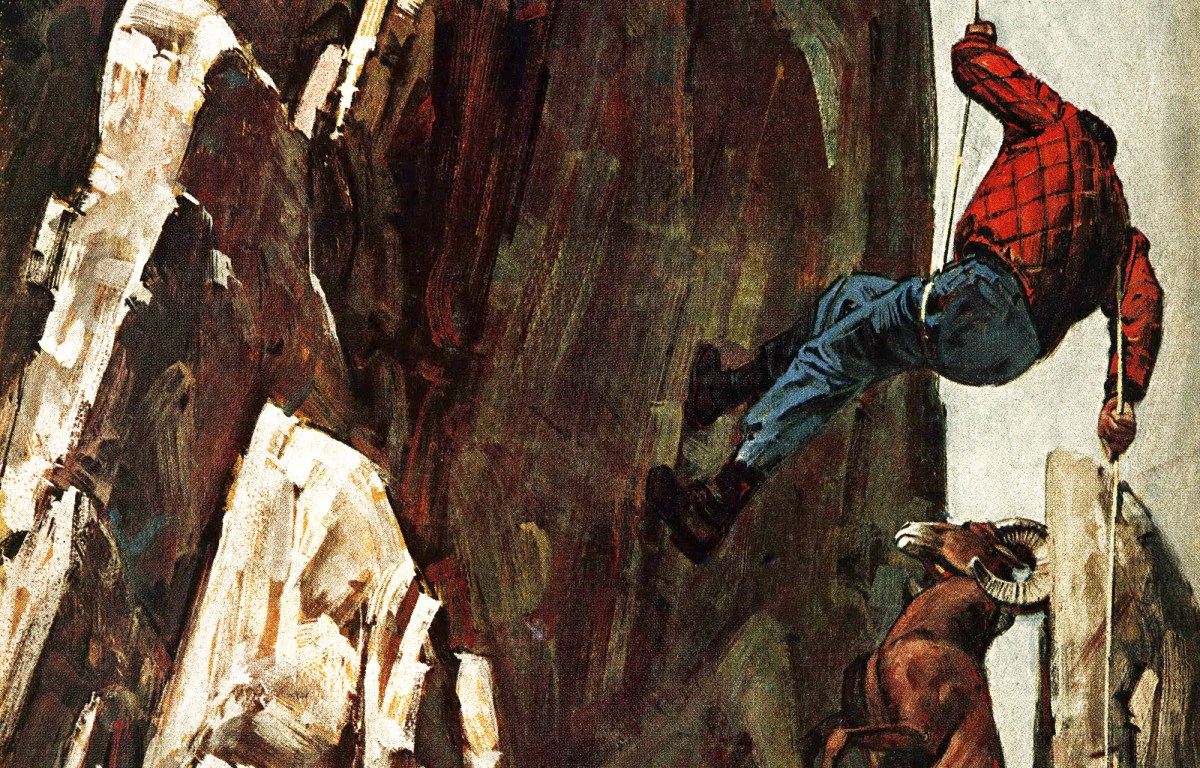
At 4 o’clock they reached the base of the cliff where the ram vanished. Careful glassing revealed the ram and showed why we hadn’t found him the night before. He had fallen into a chimney not quite as wide as his horns. The horns had caught, and there the ram was suspended. Climbing to the top, Otto lowered Barrie over on a rope to sever the head, letting the rest of the carcass drop to the base of the cliff. One horn had been splintered, but the head was complete.
Packing the quarters to the horses, the lads started to load them onto the reliable buckskin. But he wasn’t going to pack any dead animal. Finally they covered his nose in blood to ruin the scent, tied him close to a tree, and blindfolded him. When the job was done, he looked back. Seeing only the tarp covering the load, he gave no further trouble. The shale slope was negotiated with only one more mishap: the buckskin rolled 50 feet but did himself no harm.
Unfortunately, the gasoline lantern burned late that night as we talked. As a result, Barrie and I didn’t start till late next morning to check out a new theory on where the big rams were.
In a basin north of where we’d hunted opening day, we saw three rams, but with just three-quarter curls. Leaving them, we found 30 ewes farther up the valley.
At 6 o’clock, we had only one basin left to check. If our theory was correct, this must contain the big boys. The usual afternoon shower had just started when Barrie threw his rifle up to look through the Balvar SX scope and said, “Full curl.”
On a rocky bluff, with the rangefinder reticule in the Bear Cub covering only half his body, stood a ram poised for flight. We dropped down, and as the ram started to drop behind the crest, I touched off the .270. The whoomp of a hit came floating back. But in a few minutes the ram ran from beyond the bluff and was going flat out across a slide. Barrie’s lead was short, and the 7 x 61 hit just behind. The next shot from my .270 held with five feet of lead tumbled him for keeps. Dressing out and tagging the ram, I was disappointed to find it was slightly less than 35 inches. But a Rocky Mountain ram, even if he doesn’t make the book, is cause for celebration. We were still dressing out my ram when, from the last pocket, a mile down the valley, came a procession of the missing rams. They were crossing and working steadily up the far slope. Barrie might yet take the magnificent ram, which I was looking at for the second time. In the failing light, it looked even more imposing than it had before.
Leaving my ram to be skinned and quartered tomorrow, we started up a creek bed paralleling the rams’ route, hoping to intercept them at the top of the ridge. Putting all our strength into the climb, we were soon gasping for breath and drenched in perspiration.
The elusive full-curls had too much of a head start. Although apparently not in a hurry, they had dropped over to the other side. No hunter has ever run down a bighorn on foot, and our chances for a stalk were gone. Nothing remained but to head for camp. Once again the horses took us home through the darkness, passing through the marshy meadows with moose, as usual, in evidence.
Next morning all three of us and all the horses left camp. The plan was twofold: 1) we’d pack my ram, and 2) Otto and Barrie would try to locate the missing rams. A fairly good game trail took us well up the valley, and then a wide sheep trail enabled us to get the horses right into the alpine meadow where we had spotted the three small rams the day before. They were still in much the same position, and through my spotting scope Barrie thought one head was particularly pretty. I couldn’t understand his interest, with old granddad known to be in the country. But the weather was not good, and the past days — which had extended into the night — were dragging on all of us. Barrie reasoned a ram in hand was worth two in the next valley, and besides this was to be his first ram.
Through the glasses we watched Barrie make a beautiful stalk to within 200 yards of the ram and drop him with two quick shots. That was it: three of us each had a specimen of North America’s No. 1 trophy animal. Back in camp that night we drank a toast to our success. There was a toast to Otto and his ram, which when officially measured, would score 176 5/8, qualifying for the Boone and Crockett Club records. There was a toast to Barrie and his first ram. Another to me for locating the rams, and for my ram. Then there were toasts to comradeship, past hunts, and future hunts. We talked about Otto’s punishing climb, about my fine shooting, and Barrie’s perfect stalk. This was one night we could afford to burn the lantern; tomorrow we could all sleep in. In the morning we took pictures to remind us of this hunt when we are too old to climb the crags. Then we started breaking camp and loading our packstring.
Before we finished packing, company dropped in, the first people we’d seen since the start of the trip. This group, consisting of a guide and his hunter, were interested in our packing. The guide viewed our operation with a jaundiced eye, no doubt thinking this was pretty much of a farm outfit. But when we brought out the three rams’ heads to top the loads, he changed his tune. His hunter was all eyes and a million questions. He’d been hunting for over a week, wearing his feet down to his knees, with nary a look at even a ewe. Would we stay on and guide him for a few days? It would be worth a couple of hundred of dollars if we produced. But there were a dozen reasons why we couldn’t.
Wishing him well, we moved off down the trail for Calgary, two days ahead.
Read the full article here