I Joined a Horseback Posse to Track Down a Cattle-Eating, Dog-Killing Black Bear

This story, “Black Bear Posse,” appeared in the December 1963 issue of Outdoor Life.
Eight o’clock on a sunny May morning seemed like a strange time to start out after a renegade bear, but I was a tenderfoot on my way to hunt with experts, so I didn’t question the time. We were to meet at the Hatley corral, three miles east of Deary, Idaho. George Hatley owned a fine bear hound named Moon, a bluetick with a voice that wouldn’t quit. Moon would be supported on this hunt by Ted Hall’s hound Joe, veteran of 66 bear kills in these northern Idaho hills.
The hunting party that quickly assembled at the corral included George Hatley and his father Ray, ranchers and breeders of Appaloosa horses; Ted Hall, a transplanted Kentuckian who is now a lumberjack at Bovill, Idaho; Homer Tumelson, a former predator-control hunter who is now a Lewiston, Idaho, stockyard worker, and Roy Tumelson, a hunting guide and horse breeder in the Lewiston area. Also with the party were Homer Tumelson’s son and one of his high-school-age pals, a boy named Ricky Alton. Late addition to the crew was Mrs. Edith Stanger of Idaho Falls, Idaho. She was on her way home from Moscow, Idaho, after visiting her son at at the University of Idaho and attending a horse show in the area. Her husband had hunted with the Hatleys, so Mrs. Stanger stopped to visit and stayed to join the hunt.
Object of the chase was a black bear prowling the cattle range behind the Hatley place. The bruin was a suspect in several missing-calf cases. He was also a ground fighter that had several times fought off hounds that tried to tree him. He had killed one hound in such a fight. We had about decided it was going to be his last. The corral looked like a convention site. Horse trailers and cars were parked in front of the gate. Dogs were tied in pairs to bushes and trees, and colorful Appaloosa horses were being saddled for the chase. George Hatley is executive secretary of the Appaloosa Horse Club with headquarters in Moscow, Idaho. Horse hunts give George a chance to combine his favorite topics of conversation — hunting and Appaloosa horses.
There were 11 dogs in the pack, including three of Roy Tumelson’s cougar dogs, Shorty, Gerry, and Reno. If Joe or Moon got on a track, they would be with them.
George Hatley checked his .32 special Winchester, slid it into the scabbard, inspected his .38 special Smith & Wesson revolver. Roy Tumelson carried a Smith & Wesson .357 Magnum. Hall carried a Ruger .44 Magnum. Others carried light sidearms.
The dogs were untied, and we saddled up and started down the dirt road leading to the timber and sweeping mountain meadows. The sun poured down through the blue sky. It was a pleasant feeling, riding easy in the saddle on a good horse with an exciting hunt ahead. Trees had just leaved out bright and green and the meadows were scented with early flowering bushes.
I had been on a horse but once in the past 10 years, and riding a chair as a staff editor in the publications office of the University of Idaho was a far cry from a rocking saddle. But George Hatley kept mentioning how sensible his spotted horses were and how easy they were to handle, and I agreed with him. It wasn’t bad at all. The string of riders, with George Hatley in the lead, broke away from the roadway into a broad field, then into the tall grass and evergreens rising on the other side. The horses swung easily in and out of the trees. The dogs were trotting along with the horses.
We hadn’t seen any fresh bear sign and the dogs hadn’t smelled any. I’m sure it never occurred to anyone that we might suddenly see a bear while trooping along this way, but that’s what happened.
“Look,” George Hatley said excitedly, pointing to the right. “There he is.”
The black bear in the clearing turned his head in our direction and was off and running. There was plenty of excitement on our end, too. Riders left their saddles to unchain the dogs that had been running necked in pairs. Mrs. Stanger held the reins of the various horses.
In an instant the dogs were on the track of the large black bear. We were held up until a fence gate to hold cattle in the area was opened. We trotted along the fence and up a small hill to another woods road. Ted Hall stopped his horse and held up his hand for silence.
The bawl and chop of the hounds in the distance changed direction, and it sounded as if the dogs would chase the black bear right into our laps. About 200 yards away the bear turned and crossed the road in front of us. We couldn’t see it, but we could hear the commotion. That bear was moving! We spurred our horses down the road.
A narrow slit through the brush meant a familiar trail to George Hatley, the leader, and he swung his horse into it. Limbs of trees along the makeshift trail did their best to brush a rider off the saddle. The horses seemed to enjoy the hunt, and there was no holding them back.
Twice George Hatley stopped his horse to listen for the dogs. Again they had changed direction. We turned back to the road and followed the chase at a gallop. Tall pines joined their branches over the road, so that we were riding down a long tunnel of green.
I could see we were taking the easy route around the ridge. The bear chased by Joe, Moon, and company went over the tough way — straight up and down. We swung to the left again, on a trail that skirted a small creek. The creek trail led into a brushy, log-strewn meadow. We went at a gallop across this rough terrain, and I hoped what George had said about the surefootedness of my horse was true.
I could hear Moon’s booming voice, a cross between the steam whistle of the U.S.S. America and the howl of a dog with his tail caught in a door.
At the head of the meadow we stopped again to listen for the dogs. I could hear Moon’s booming voice, a cross between the steam whistle of the U.S.S. America and the howl of a dog with his tail caught in a door. The bear was crossing the canyon we were in, moving up the ridge toward the next canyon.
“From here on it might get a bit rough,” George grinned. He cut to the right at a trot and entered a thicket. Moving single file through the brush was a battle. Riders would lean far to one side or the other to keep from getting batted by the branches. Finally another mountain meadow appeared.
A band of cattle was being spooked out of the woods into the meadow. The chase again had crossed in front of us. We were at a gallop again, but by this time I was getting used to it, rough ground or not. We battled through a small thicket and out into another meadow.
The dogs were closer now, chasing the bear into the meadow we were entering. Ahead and to the left, we could see several dogs milling around. Then we saw the bear for the second time. He looked huge. George Hatley drew the rifle from the scabbard, but before he could get off a shot the bear was back in the woods.
“Those dogs look all fought,” Ted Hall said. “We’re going to to kill that bear on the ground.”
George Hatley was off his horse, handing the rifle to his father Roy.
“We’d better spread out and move in on him,” George said. “It sounds as though the dogs have him pretty tired.”
The three men began to move into the dense thicket with the stealth of an infantry patrol in enemy territory. They were taking no chances.
Roy Tumelson, who was still on his horse farther back in the meadow, yelled, “Hey, the dogs are on the chase again. They’re moving him back up the canyon.” The two Hatleys and Hall were soon mounted again and we
were off and riding.
We didn’t go far, and it was a good thing. The woods were getting denser and more rugged.
What stopped us was the most sorrowful, difficult-to-describe sound I’ve ever heard. It was old Moon’s howling, moaning voice telling us the bear was treed. Moving closer, we could hear the other dogs barking tree.
We rode within 35 yards of the tree. Horses were tethered to branches and we moved to the base of a large cedar. About 50 feet up, panting on a limb, was the bear.
The bear appeared to be done in. So were the dogs. It had been a hard chase, more than five miles by horse, closer to 10 the way the hounds went. Mrs. Stanger looked at her watch and said it was just 10 o’clock, which meant we’d been riding less than two hours.
“I’m sure that’s the renegade,” George Hatley said. “This isn’t over a quarter of a mile from where he fought off the dogs two years ago.”
“Sure looks like him,” Roy Tumelson added. “Who’s going to shoot him?”
Mrs. Stanger declined. I wanted to get some pictures of the bear hitting the ground, so Ricky Alton, young Tumelson’s friend, was elected. George Hatley handed him the rifle and explained, “Take a careful aim and hit him in the neck.”
The dogs were caught and moved away from the tree to keep any from getting injured when the bear dropped.
“All ready?” the boy asked. “Go ahead.”
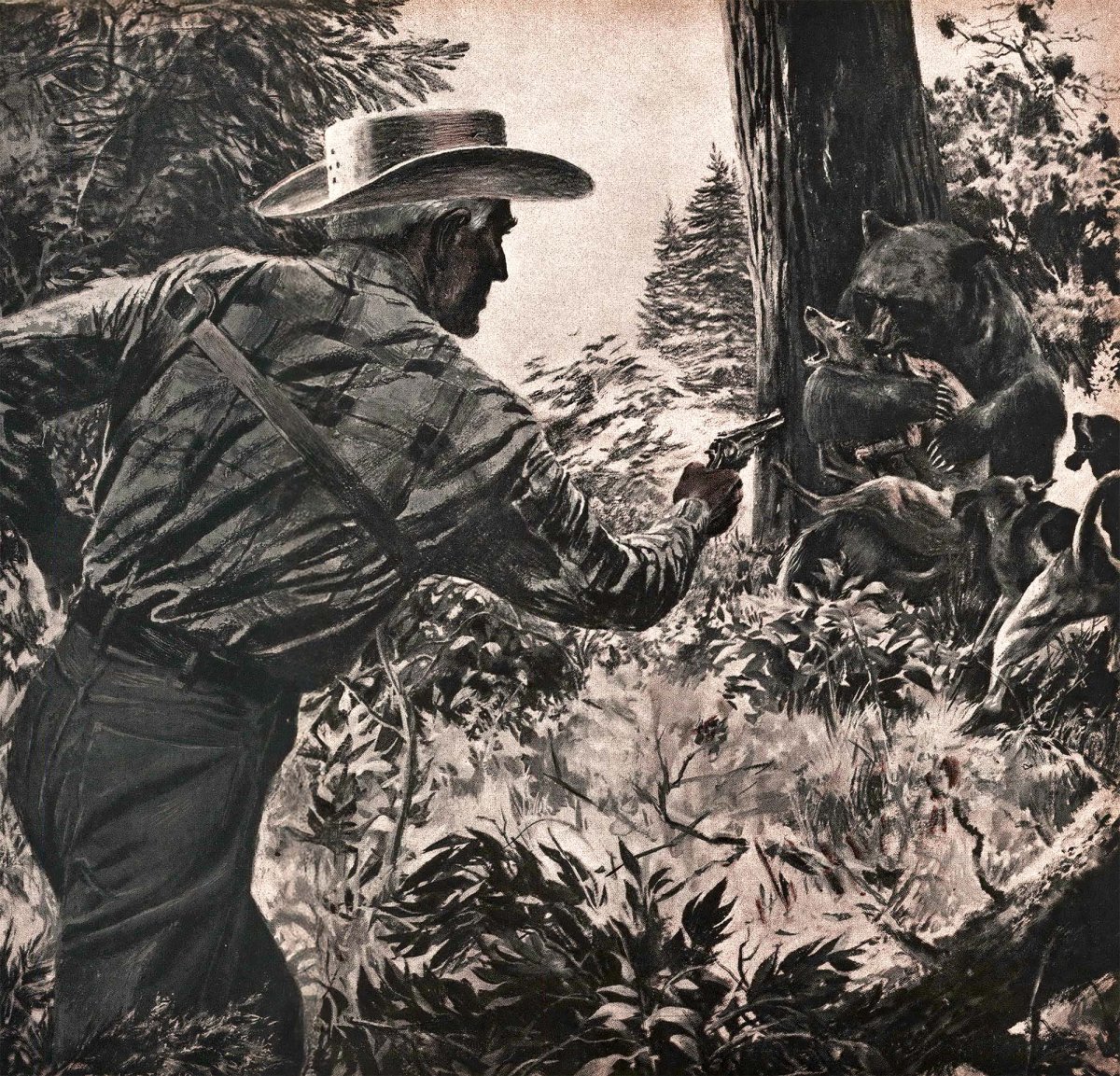
The rifle cracked and the bear tumbled out of the tree and thudded to the ground. But he wasn’t finished. The rifle bullet had just grazed the neck. The dogs rushed to the scene, eager to sink their teeth into the bear hide as a reward for a difficult chase. The bruin rose on his hind legs, forearms spread wide. Brindle, one of Hall’s dogs, made a dive for the bear’s throat. The bear held the dog for a moment in his strong arms and raked Brindle’s head with his teeth. Somehow the dog squeezed out of the grip.
Roy Tumelson fired twice, one of the .357 slugs driving into the bear’s belly. The bear bolted into the brush like a light tank. And I missed the picture! The dogs were soon scrapping with the bruin about 50 yards away. George Hatley lunged into the thicket, crowding close to the fight — too close for my comfort. He cocked his .38 and snapped off a shot that hit the bear’s head.
That was it. The bear slumped to the ground under a swarm of dogs.
“You probably will never go on a wilder hunt than this,” said George.
Hall inspected the bear. “This is one of the biggest bears we’ve killed. How’d you like to have a bear rug, Mrs. Stanger?”
“I sure would,” she answered, no doubt thinking that this would put her one up on her husband, who missed getting a bear on his trip.
“This hunt has some firsts for me,” Homer Tumelson said. “It’s the first time I ever saw a bear on the ground before the dogs were turned loose and the first time I’ve seen one on the ground again before he treed. Tumelson gutted the 300-pound bear.
Then it was dragged downhill to a clearing and the horses were moved in.
It took four men to load the bear on a blindfolded horse and tie it down. George Hatley warned everyone to move away before the jacket blindfold was removed from the animal’s head, but the horse didn’t move a muscle.
After the bear was on the packhorse the men began checking dogs. Brindle had been injured and Reno was cut above both eyes and on the neck. One dog was missing. George Hatley blew a blast on his cow-horn trumpet. A few minutes later the missing dog appeared, tired and sweaty. He had been following a back track.
A trail weaving in and out of the flower-strewn mountain meadows led back to the corral. The sky was as blue as the camas flowers, except for the white trail of a jet plane miles high. Except for this reminder of the present, the horses, dogs and riders ahead of me could have been a hunting party from the pioneer days of the West. I’m sure hunts were conducted much the same way then.
Read the full article here