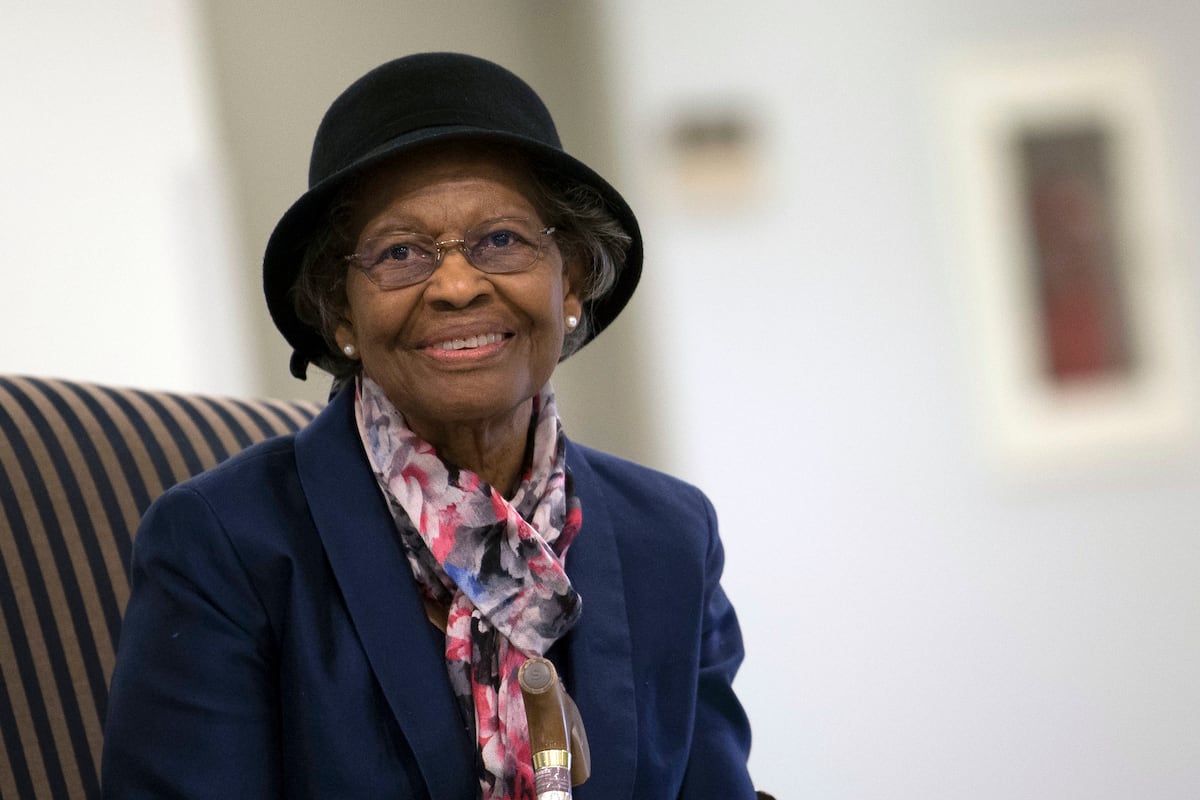

Gladys Mae West, whose mathematical work became the integral foundation for modern GPS, has died.
West, surrounded by family and friends, passed away peacefully on Jan. 17. She was 95.
Born in rural Dinwiddie County, Virginia, in 1930, West sought to leave her family farm from the beginning.
“I guess I found that a little bit contrary to what I had in my mind of where I wanted to go,” she told the BBC in 2018.
For most living in the Jim Crow South, career options were limited, but West didn’t want to stay and pick tobacco, corn or cotton for a living — or work in the nearby factory beating tobacco leaves into pieces for cigarettes and pipes.
One of the “hidden figures” in American history, West’s mind took her far from her life in rural Virginia.
“I thought at first I needed to go to the city. I thought that would get me out of the country and out of the fields,” she told the BBC.
“But then as I got more educated, went into the higher grades, I learned that education was the thing to get me out.”
One of the few female students to graduate Virginia State University with a degree in mathematics, West’s genius secured her a position in 1956 at the Naval Support Facility Dahlgren, then known as the Naval Proving Ground. She was just one of four Black employees and only the second Black woman hired at the facility.
One of those Black employees, Ira, would become her husband for more than 67 years before his passing in 2024.
As a programmer for large-scale computers and then a project manager for data-processing systems used in the analysis of satellite data, according to the Royal Academy of Engineering, “West began to analyze data from satellites, putting together altimeter models of the Earth’s shape.”
West would serve as the project manager for the “Seasat radar altimetry project, one of the first satellites that could remotely sense oceans,” the academy noted. “West introduced innovations, cutting her team’s processing time in half, and was recommended for a commendation in 1979.”
Throughout the 1980s West was at the forefront of designing, developing, testing and then programming an IBM 7030 “Stretch” computer to deliver increasingly precise calculations to model the shape of the Earth — an ellipsoid with irregularities, known as the geoid, according to the RAE.
Her pioneering algorithms and subsequent data ultimately underpinned the mapping functions of modern-day GPS. (While the mother of of GPS, West once professed that she preferred a paper map to get around.)
“I think that Dr. West is another one of those hidden figures in our military that play a critical role in the advancements that not only affected our ability to fire missiles accurately but also enable everyday life when you pick up your phone and you’re trying to find something,” retired Navy Rear Adm. Sinclair Harris said during a 2023 ceremony honoring West.
Despite West’s nonpareil accomplishments, it was only after Gwen James, a member of West’s university sorority, read the short biography she had submitted for an alumni function in 2017, that the mathematician’s contributions to the U.S. Navy and beyond came to light.
Despite knowing one another for 15 years, James had no inkling of West’s outsized impact.
“GPS has changed the lives of everyone forever,” James told The Free Lance-Star in 2018. “There is not a segment of this global society — military, auto industry, cell phone industry, social media, parents, NASA, etc. — that does not utilize the Global Positioning System.”
West retired from the naval facility in 1998 after more than 40 years of service, but she wasn’t done. Despite suffering a debilitating stroke that affected her hearing, vision, balance and mobility, West went on to earn her PhD from Virginia Polytechnic Institute and State University at the age of 70.
“All of a sudden,” she recalled to BBC, “these words came into my head: ‘You can’t stay in the bed, you’ve got to get up from here and get your PhD.’”
But getting up to quietly fight for success was nothing new for West.
“We have made a lot of progress since when I came in, because now at least you can talk about things and be open a little more,” West said regarding working women.
“But they still gotta fight.”
Claire Barrett is an editor and military history correspondent for Military Times. She is also a World War II researcher with an unparalleled affinity for Sir Winston Churchill and Michigan football.
Read the full article here