
After the U.S. Marine raid on Makin Island on Aug. 17-18, 1942, Japanese garrisons in the Gilbert and Marshall islands got to serious work reinforcing their commands. These took different natures, with differing effectiveness. In the case of Tarawa Atoll in the Gilberts, the defenses focused on some 500 positions, combining solid concrete, resilient coconut logs and the sand that made up the island.
Central to the defenses was a mammoth bunker capable of accommodating 150 troops and an airfield in the middle of Betio, the largest island in the Tarawa group. When he arrived on July 20, 1943, to take command of some 5,000 men of the Special Naval Landing Force, Rear Adm. Keiji Shibazaki had boasted that it would take a million men and 100 years to take the island. The Marines took it in three days.
But at a high cost.
Tarawa proved a formidable target, not least because of an intelligence miscalculation that led to American landing craft being hung up quarter mile from the beachhead and resulting in hundreds of casualties before the Marines even reached the shore.
The Japanese started with a few disadvantages of their own. Betio airfield was quickly put out of action and U.S. Navy carrier planes also eliminated the air bases in the neighboring Marshalls as a threat.
Worse still, by a twist of fate, a fluke or skill, one of the U.S. destroyers managed to lob a 5-inch shell directly in the Shibazaki’s path as he left his concrete blockhouse — instantly killing him and several other senior officers.
The death of Shibazaki essentially cut off the head of the Japanese command structure, which is seemingly why the Japanese could not coordinate an early banzai charge to force the Marines back into the sea.
At least one of the few Japanese taken prisoner attributed one other, most vital factor. It was when he saw hundreds of Marines falling at the reef, while others exited their landing craft and kept on coming until they secured a toehold on the beach, that he began to doubt the outcome.
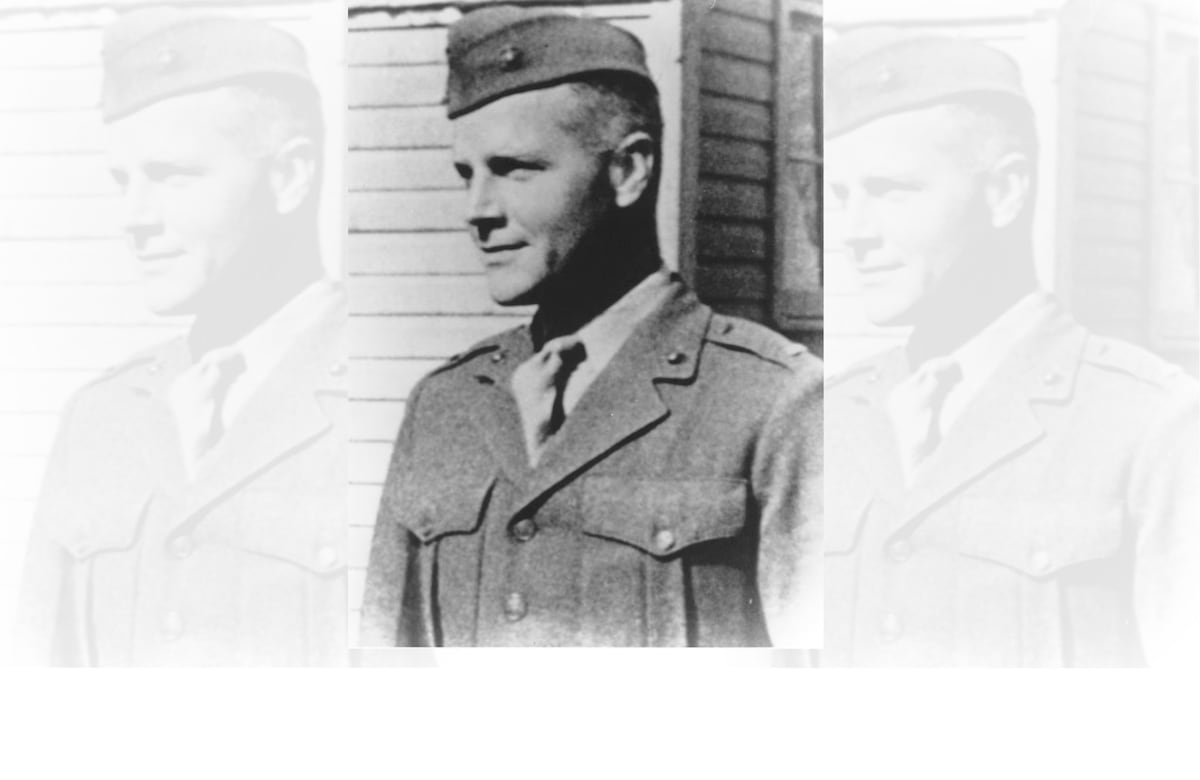
Among the Marines who made that formidable impression was a field-commissioned lieutenant named Alexander “Sandy” Bonnyman. From the first to the last day, his name came to be associated with the keystone of the Japanese defense.
Born in Atlanta, Georgia, on May 2, 1920, Bonnyman was in his infancy when his family moved to Knoxville, Tennessee, where his father was president of the Blue Diamond Coal Company. While at Princeton University, he majored in engineering and excelled in football, but dropped out after his sophomore to enlist in the U.S. Army Air Corps on June 28, 1932.
After training at Randolph Field, Texas, he was honorably discharged “by reason of flying deficiency.” After that he worked in the coal industry, moved to New Mexico and established his own copper mine business.
When the Japanese raid on Pearl Harbor on Dec. 7, 1941, Bonnyman was exempt from the draft because he ran a company producing strategically vital war material. In spite of that, in July 1942, he enlisted in the U.S. Marine Corps as a private and trained in San Diego, California.
In October 1942 he shipped out aboard the SS Matsonia to the Solomon Islands. There, he served in a Marine Pioneer unit on Guadalcanal with such a demonstration of leadership qualities that he got a field commission as a second lieutenant in February 1943.
After another promotion to first lieutenant in September that year, Bonnyman saw his next combat at Tarawa on Nov. 20 as executive officer to the 2nd Battalion, Shore Party, 8th Regiment, 2nd Marine Division.
Surviving that first bloody day of the landings, he brought his civilian experience into play, along with his skill in shore party handling and beachhead logistics. When his party encountered resistance at the seaward side of Betio Pier, he organized and led a five-man detachment to charge over the open pier and secure it. He also obtained several flamethrowers and demolitions to blow up several enemy installations.
On Nov. 21, Bonnyman led a 21-man demolition team against the main bomb-proof shelter, which by then lay 40 yards ahead of the Marine lines, barring further progress.
Gathering grenades and explosive charges, he directed the fighting under heavy fire, then retired to gather up more. He led his men to the mouth of the giant bunker, killing many defenders, but by day’s end the Japanese bunker was still dominating the area.
Bonnyman and his detachment, backed up by Marine riflemen and a tank, renewed their effort on the 22nd, climbing to the top of the structure. At that point, about 100 Japanese, either losing their nerve or seeing the need to spread out their remaining forces from other positions, made a break out of the bunker — only to be picked off by Bonnyman’s Marines.
During the final fight at the bunker, Bonnyman and his detachment were followed by combat cameraman Norman Hatch, whose footage appeared in “With the Marines at Tarawa.” It included pictures of Bonnyman and his detachment firing at Japanese trying to escape their bunker, giving Bonnyman the distinction of being the first Medal of Honor recipient to be captured in the act.
Some returned fire and Bonnyman, firing from the forward edge of the bunker, killed three of them, then ordered more charges. However, just then Bonnyman was struck and mortally wounded by enemy fire. Yet his sacrifice inspired his men to carry on the fight to completion. After the next, final furious minutes of fighting, 13 of Bonnyman’s detachment were still standing, but the bunker was theirs and all of its defenders dead.
The Marines suffered no further casualties as they advanced the 400 yards beyond the bunker and on Nov. 23 Betio Island was declared secure. It had cost the Marines 1,021 dead and 2,110 wounded, as well as 687 Navy personnel, while the Japanese lost 4,690 dead, 17 taken prisoner and 129 Korean laborers likewise taken alive.
In 1947, 12-year-old Frances Bonnyman received a posthumous Medal of Honor for her father from Secretary of the Navy James Forrestal. Alexander Bonnyman was among 36 “non-recovered” Marines interred on the Betio battlefield until a later relative, Clay Bonnyman Evans, wrote a biography and an appeal in “Bones of my Grandfather: Reclaiming a Lost Hero of World War II.”
In August 2015, Bonnyman’s remains were recovered, identified and returned to his family. On Sept. 25, 2015, he was finally laid to rest at the family plot at West Knoxville’s Berry Highland Memorial Cemetery.
Read the full article here