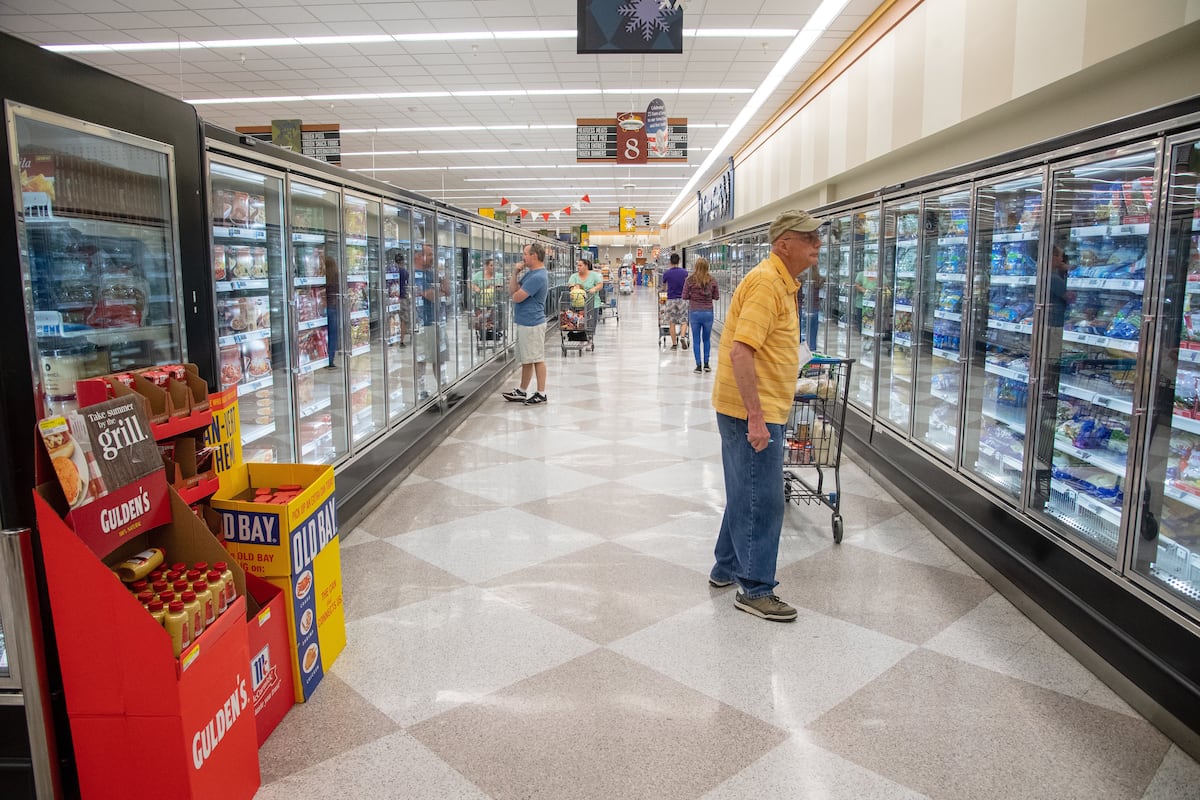

Eligible commissary shoppers near an additional 62 military commissaries will be able to have discounted groceries delivered to their doorstep within a month, the head of the company that is to provide the service told Military Times on Wednesday night.
Defense Commissary Agency officials have awarded a contract for the delivery to OnPoint, a delivery service previously known as ChowCall, said Todd Waldemar, founder and CEO of the company. The 70 commissaries that are part of the contract include eight pilot locations that have been offering the delivery service since 2022. Waldemar said the remaining 62 stores will be offering the service by Jan. 11.
“These 70 include the largest military markets, so I estimate that they represent over half of the total [U.S.] military population,” Waldemar said.
A spokesman for commissary officials did not immediately confirm the award of the contract, and it had not been published on Sam.gov by the time this article was published.
The contract includes the flexibility to expand to the remaining 108 commissaries in the United States. That expansion to all 178 commissaries is optional and is up to the commissary agency, Waldemar said.
“But we hope to get delivery in all markets as soon as we can. I think it would be realistic to see all markets have delivery by the summer,” he said, emphasizing that he does not speak for the commissary agency.
Commissary officials are not considering doorstep delivery for overseas commissaries because of overseas regulatory constraints.
The initial contract award is for $14 million, Waldemar said. Delivery will be available within a 20-mile radius of the commissaries.
Commissary officials have provided an online, curbside pickup service for customers for a number of years, and have been working to find a way to provide the delivery service, too.
“We need this. Our customers want and need this contract,” John Hall, director of the Defense Commissary Agency, told a meeting in March.
“I’m really excited about this,” he said at the time.
Under the system, customers order groceries online, which are retrieved by store employees who pick the items and hand the orders over to OnPoint. OnPoint then delivers the groceries to the customer’s location. The delivery can occur as soon as three hours after the order is submitted, depending on the location, because commissaries need the time to pack the order.
The commissary agency will not subsidize the delivery costs for customers. The fee will be $17.75 for those within 10 miles and $31.25 for those within 11 to 20 miles. The commissary agency does not have the flexibility in pricing delivery fees that commercial retailers do, because of their limitations in marking up prices, for example.
Customers pay the delivery fee in addition to the cost of their groceries, the usual 5% commissary surcharge, and any tip for the driver.
RELATED
OnPoint has been gearing up for the expansion, and is also hiring delivery drivers in all 70 areas, Waldemar said. About 80% of their employees are affiliated with the military, as spouses or veterans, for example. They are paid according to the wage scale under the Service Contract Act, which varies from area to area, and also receive fringe benefits, he said.
ChowCall/OnPoint has delivered more than 40,000 loads of groceries since beginning commissary deliveries in June 2022, Waldemar said.
Customers using the current delivery pilot program range from active-duty families to troops living in barracks, retirees and disabled veterans and people who want to get a head start on shopping or a bite to eat while at work. The service can be especially helpful to young families of troops who are deployed, such as spouses with young children, Waldemar said.
More than 50% of customers using the delivery are within 5 miles of their commissary, he said.
Those eligible for the commissary shopping benefit include active-duty, Guard and Reserve members, military retirees, Medal of Honor recipients and their authorized family members. Veterans with any Veterans Affairs Department-documented, service-connected disability rating are now eligible for commissary shopping, as well as Purple Heart recipients, former prisoners of war and those who have been approved and designated as the primary caregivers of eligible veterans by the VA.
Waldemar said he has received positive feedback from customers about the delivery, including some disabled veterans who said they depend on the commissary delivery. One veteran who cannot drive called it a lifeline, Waldemar said.
“Our mission is to really solve this problem, and really make a big impact across the whole military for quality of life,” Waldemar said. His company has made over 2 million deliveries of food and merchandise to military bases for 15 years, he said.
“The problem as we see it, is that the delivery of goods and services is either nonexistent or minimal in most military markets,” he said. So those who live and work on military bases do not have as many options as everyone else does, he said, partially because access to military bases is harder.
“We want to solve that problem by giving more options to the military, more options to the dependents in family housing, more options to the young service member who doesn’t have a vehicle, stuck in the barracks.
“My son, for example, just enlisted in the Air Force. He’s living in barracks. He told me the other day, totally unsolicited, ‘Dad I finally understand what your company does,’ because he’s on a base where all he can get is pizza from the gas station down the road.
“That’s it. We want to totally change that. We want to have options, we want to have convenience for everybody that’s on bases.”
Alabama
- Fort Rucker (formerly Fort Novosel)
Arizona
- Davis-Monthan AFB
- Fort Huachuca
- Luke AFB
California
- Camp Pendleton MCB
- Miramar MCAS
- San Diego NB
- Ord Military Community
- Travis AFB
Colorado
Connecticut
Florida
- Eglin AFB
- Hurlburt Field
- Jacksonville NAS
- MacDill AFB
- Patrick SFB
- Pensacola NAS
Georgia
- Fort Benning (formerly Fort Moore)
- Fort Gordon (formerly Fort Eisenhower)
- Fort Stewart
Hawaii
- Hickam JBPHH
- Kaneohe Bay MCBH
- Pearl Harbor JBPHH
- Schofield Barracks
Illinois
Kansas
- Fort Leavenworth
- Fort Riley
Kentucky
Louisiana
- Fort Polk (formerly Fort Johnson)
- Barksdale AFB
Maryland
Mississippi
Missouri
- Fort Leonard Wood
- Whiteman AFB
Nebraska
Nevada
New Jersey
New York
- Fort Drum
- West Point Military Academy
North Carolina
- Camp Lejeune MCB
- New River MCAS
- Fort Bragg North & South locations (formerly Fort Liberty North & South locations)
North Dakota
Ohio
Oklahoma
Puerto Rico
South Carolina
Texas
- Fort Bliss
- Randolph AFB
- Fort Sam Houston
- Lackland AFB
- Fort Hood-Clear Creek location (formerly Fort Cavazos-Clear Creek location)
Virginia
- Fort Eustis
- Langley AFB
- Little Creek JBLCFS
- Norfolk Naval Station
- Oceana NAS
- Fort Belvoir
- Fort Myer
- Fort Lee (formerly Fort Gregg Adams)
- Quantico MCB
Washington
- Fort Lewis Main
- McChord AFB
- Whidbey Island NAS
Karen has covered military families, quality of life and consumer issues for Military Times for more than 30 years, and is co-author of a chapter on media coverage of military families in the book “A Battle Plan for Supporting Military Families.” She previously worked for newspapers in Guam, Norfolk, Jacksonville, Fla., and Athens, Ga.
Read the full article here