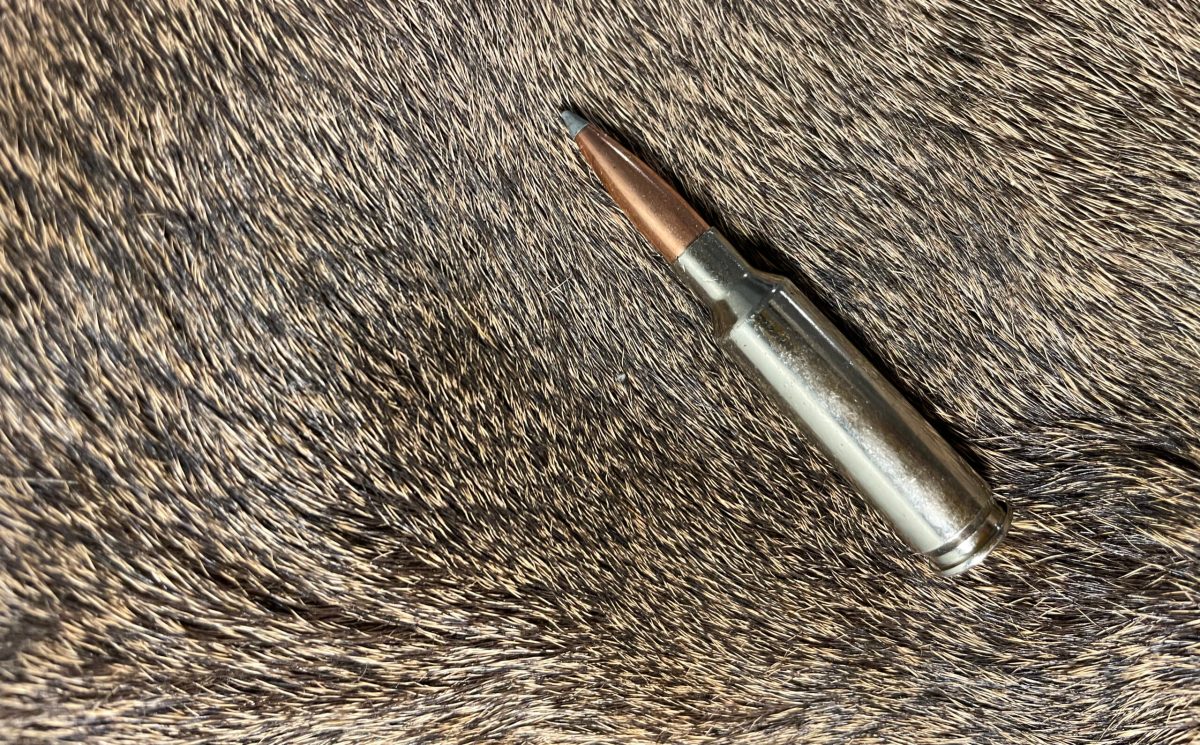

For years now we’ve heard from rifle and ammo manufacturers that the 6.5 Creedmoor is their most popular cartridge. It’s an excellent round for open country, and it’s found its way into plenty of Midwestern and Eastern deer camps, too. But there’s one consideration that’s become a head scratcher. A whole bunch of deer hunters are reporting sub-par blood trails — even on well-hit deer — shot with their 6.5 Creeds.
Just ask full-time Wisconsin blood-tracker Dean Muthig. When I spoke with Muthig a few years back, he had put his Bavarian mountain scent hounds on 230 deer tracks so far that season. Many of his calls over the years have been from parents who need help recovering deer during the youth rifle season. Not because their kids are making poor shots, though. Muthig says younger hunters seem to shoot just as accurately as adults. Instead, it’s because they tend to use smaller calibers like a .243 — and the 6.5 Creedmoor. In other words, it’s not that these kids aren’t killing deer. They just can’t find them.
Consider the 9-year-old boy who shot a nice buck on a Wisconsin food plot. The 8-pointer fled into a stand of pines, which his family searched without finding a speck of blood. When Muthig arrived, his hound lead him directly to the buck. It had run 175 yards before piling up from the double-lung shot. The bullet had not exited, and there was no visible blood on the entire track.
Read Next: What Is the Best Caliber for Deer?
“The kid made a great shot, but it’s just one of those things where the deer didn’t bleed at all,” says Muthig, who’s been tracking for 17 years. “The 6.5 Creedmoor is like a .243 where — they kill deer, don’t get me wrong. There are a lot of people who kill deer with them. But they just don’t leave a blood trail, hardly ever. And it’s just because it’s such a small entry hole … It’s the size of a pencil, and a lot of times the bullets go in and expand and there’s no exit, and nowhere for the blood to go. … Or if it does exit, there’s not a lot of room for blood to get out. Running deer cover a lot of ground fast, so you can end up with really minimal blood in the course of a few hundred yards.”
There are lots of things to consider when it comes to cartridge selection for killing deer. And they’ve all been debated to the point of exhaustion by hunters and hunting publications like ours. But when it comes to recovering those deer, especially when hunting with a 6.5 Creedmoor, there’s still plenty of confusion. So what’s the deal? Is there an issue with the cartridge? Or are there other factors at play?
Understanding Sectional Density and Bullet Selection
A common criticism of the 6.5 Creedmoor is that it’s not powerful enough to pass through big game animals. But all things being equal, says Outdoor Life Shooting Editor John B. Snow, a 6.5 bullet will theoretically out-penetrate many other bullets because of its sectional density. Sectional density is the relationship between the diameter of a projectile and its weight. Let’s say a 30-caliber bullet weighs 180 grains, and compare that to a smaller-diameter 7mm bullet that also weighs 180 grains. The 7mm bullet has a higher sectional density, which means it will penetrate better.
“This is why we can kill animals with arrows,” Snow says. “They have amazing sectional density. That’s how you can get a pass-through on an elk.”
But even if you have a higher sectional density with the 6.5 Creedmoor, that doesn’t necessarily mean you’ll get a heavy blood trail on a pass through. Also, sectional density doesn’t always play out so nicely under real-world conditions because bullets deform upon impact.
“That’s what we’ve been taught. That’s what I was taught. The reality of that is actually more complicated,” says Snow in this week’s episode of the Outdoor Life Podcast. “When you look at how bullets behave in [ballistic] gel and kind of analyze
them from that standpoint, the sectional density thing doesn’t quite hold up the way that we were taught.”
| Bullet | Caliber | Weight | Sectional Density |
| Hornaday ELD-X | 6.5mm | 143 grain | .293 |
| Hornaday ELD-X | .308 | 178 grain | .268 |
| Nosler AccuBond | 6.5mm | 140 grain | .287 |
| Nosler AccuBond | .308 | 180 grain | .271 |
So what does this mean for hunters who don’t want to wade into ballistics, and just want to recover their deer? It means they need to choose the right bullet for their desired outcome.
“If you like two leaky holes, and there’s a lot to be said for that, you’re going to want to shoot something like a Nosler AccuBond, a Barnes Monolithic, or a Hornaday GMX. The Federal Fusion-Tipped is also a good choice,” Snow says, noting that these recommendations hold true for cartridge selection beyond the 6.5 Creed. “If you want lots of internal damage but not necessarily a pass-through, look at the Hornaday ELD-X or a Nosler Ballistic Tip — any of those lighter, polymer-tip bullets should fit the bill. Just know that there’s still a chance that it’ll blow through the deer.”
If you wanted to kill something slightly bigger than a whitetail (like, say, an elephant) a 6.5-caliber is still plenty capable. The legendary ivory hunter W.D.M. Bell favored 6.5 calibers, often shooting 165-grain round-nose bullets, to reliably and effectively kill elephants.
Read Next: 6.5 Creedmoor vs .308 Winchester
Bell was a proponent of shot placement over big-bore power for making clean, lethal shots. And that’s the kicker. He’s known for taking and perfecting skull shots on those elephants. Which leads us to what is arguably the most critical factor when it comes to retrieving deer.
Shot Placement with the 6.5 Creedmoor
Several seasons ago, editor-in-chief Alex Robinson made a marginal shot on a broadside mule deer at 260 yards with a 6.5 Creedmoor. His bullet, a 129-grain Browning BXR, hit the buck through the back of the lungs and front of the liver, and exited. The buck leapt into a field and disappeared from sight. Robinson and his hunting partners found a decent blood trail through the cut field and recovered the deer 400 yards later. The BXR bullet is designed for rapid expansion (in concept, it’s very similar to Winchester’s Deer Season ammo). Bullets like these are designed to mushroom quickly, and they typically create larger exit wounds and better blood trails—if they exit. Because Robinson’s shot didn’t hit any substantial bones, it was able to pass through, even though the placement was less than ideal.
Compare that to a deer hunt Josh Dahlke of HuntStand Media experienced this fall. Dahlke has cleanly killed more than a dozen big-game critters with Federal’s Terminal Ascent 130-grain and 140-grain bullets in 6.5 Creedmoor. This tally includes whitetail, mule deer, elk, pronghorn, and hogs. Regardless of the species, on quartering-to shots where the bullet must pass through the animal’s shoulder, Dahlke has not gotten an exit. This was never a problem, however, because the animals have always gone down in sight.
“I’ve hunted mostly open country and the animals I’ve shot have not gone more than 100 yards,” Dahlke says. “To me, it’s the ultimate open country hunting round for mule deer and smaller.”
But it might not be the ideal cartridge for hunting deer in the woods. On a recent hunt in Wisconsin, Dahlke made a quartering-to shot on a buck at 80 yards. His 130-grain Terminal Ascent bullet broke the buck’s shoulder and the deer bolted into the woods. When he went to recover it, he didn’t find a drop of blood. He also couldn’t find the buck.
Instead of stumbling around the woods in the dark and potentially bumping the deer onto the neighbor’s property, Dahlke opted to back out and track the deer in the morning with the help of blood-trailing expert Shane Simpson. He and the dog found the buck quickly, piled up only 60 yards away from the hit site and not more than 20 yards from where Dahlke had stopped looking the night before. Luckily, the deer hadn’t been ravaged by coyotes overnight. Even after the recovery, they found not a drop of blood.
“The bullet performed exactly like it was supposed to, but still, that whole experience really got me thinking about changing to a heavier caliber for hunting woods whitetails,” Dahlke says.
Blood Trackers Advise Skipping the Shoulder Shots
For his part, Muthig, the Wisconsin deer tracker, advises against shoulder shots with smaller-caliber deer rifles. His reasoning applies more to hunters who haven’t selected the proper bullet for that kind of shot. He says that many of the tracks he’s been called on in his 17 years as a blood-tracker have been for shoulder shots.
“There’s going to be a lot of rifle hunters who disagree with me and say, ‘Man, every deer I shoot with a rifle I shoot in the shoulder, and it drops right there.’ And the tracker will say, ‘Until they don’t,’” says Muthig, explaining that he sees more bad shots in one year than most hunters see in a lifetime. “If you’re aiming for the shoulder and miss your spot, there’s just meat and bone up there.”
During rifle season, Muthig prefers to hunt with a .30/06 and aims just behind the shoulder for a double-lung shot. Simpson advises hunters (using any method—bow or rifle) to aim for the vital V: the lower third of the deer, just behind its elbow. While this is very good advice for bowhunters who have to worry about deer ducking the string, it can also help rifle hunters: A lower exit wound can create better a blood trail.
“Shoot as big a caliber as what you’ll tolerate just to give yourself some room for error,” Muthig says. “Not that you aren’t going to kill deer [with a smaller one]. You’re just going to have an easier time tracking them.”
The Upshot: Terminal Ballistics Are Impossible to Predict
A few days ago, I helped my cousin track a big Indiana buck that had run off at the shot. My cousin, who was shooting his 6.5 Creed, said he’d placed the shot right behind the deer’s shoulder. This was only the second deer he’d ever shot, and I listened to his story about how the buck had simply turned and ran into the woods without exhibiting any signs — jumping, kicking, hunching, running extra fast — that might indicate the type of hit. I concluded it was either a clean miss or that the deer was lying dead in the woods somewhere.
Four of us, including a deer hunter with 55-years of experience searched for sign. We found only hair at the shot site, and not a single drop of blood on the standing corn, fescue, native vegetation, or leaves. Finally, I stepped into the woods at the place my cousin had last seen the deer run, and glassed with my binoculars. I spotted just a patch of gray and an antler tip. His buck was lying dead in the woods, perhaps 60 or 70 yards from the shot site.
The next day, I helped my uncle load up a buck he’d shot nearby. That deer behaved similarly to my cousin’s. Each buck had been shot behind the shoulder at about 100 yards and run about 60 yards. Both bullets passed through vitals. Neither deer left a blood trail, nor had blood dripping from the nose or mouth. The main difference? My uncle had been hunting with his dad’s old wood-stocked .30/06.
It’s a reminder that while we hunters can rely on our accumulated experiences, we can never predict terminal ballistics.
Anyone who enjoys arguing about cartridges is likely familiar with this principle. If you flip to page 54 of the Handbook for Shooters and Reloaders Vol. II by P.O. Ackley, you’ll find printed there, in all caps, this phrase: NO TWO WOUNDS WILL BE FOUND EXACTLY ALIKE. This conclusion was drawn by Frank Chamberlin, a WWII trauma surgeon and wound ballistics researcher who published an extensive study in 1966 on bullet wounds and terminal ballistics.
“It’s a fascinating topic and a fascinating thing to study,” says Snow. “But if you want a particular outcome you have to tailor your bullet selection to that outcome — with all the tradeoffs inherent. To make a statement that this caliber or that caliber is sufficient or insufficient is missing the point.”
While Muthig fields plenty of calls from hunters who shot deer with their 6.5 Creedmoor, he says that’s partly just because it’s a popular cartridge in the deer woods. He also gets lots of calls from hunters who shoot the popular .30/06 and need tracking help.
“If you want to kill deer, I don’t think it really matters what caliber you use,” says tracker Shane Simpson. “You could use a .22 caliber bullet and you’re going to kill the deer if you hit it in [the right spot]. Shot placement is critical with those smaller calibers [like the 6.5 Creedmoor].”
Read Next: Most Accurate 6.5 Creedmoor Ammo, Tested
Another factor that might be contributing to tougher blood trails, points out Snow, is that a lot of new adult hunters have gravitated to the 6.5 Creedmoor. It’s a popular and widely available offering with low-recoil.
“The blood trailing issues could be the inexperience of the hunters in question,” says Snow. “That’s not damning the hunters — they’re new hunters. And it’s certainly not damning the cartridge. I’ve had plenty of bloodless deer with all kinds of cartridges.”
At the end of the day, the best thing deer hunters can do is control all the factors we can, as best as we can. That includes everything from selecting the best cartridge for you, with consideration for both the caliber and bullet, to practicing often enough to make repeatable, ethical shots. And then, once you’ve done all you can do to prepare for your deer hunt, expect to be surprised anyway.
Alex Robinson contributed reporting. This story was first published on Dec. 17, 2021; it was revised and updated on Dec. 3, 2025.
The Best Deer Hunting Rifles
Read the full article here